
NRC Ratings Explained: What the Numbers on Your Spec Sheet Actually Mean
Learn what NRC ratings really mean, how they are calculated, what they hide, and how to read acoustic panel test data before specifying a product.
NRC is one of the most common numbers on an acoustic panel specification sheet.
It is also one of the easiest to misunderstand.
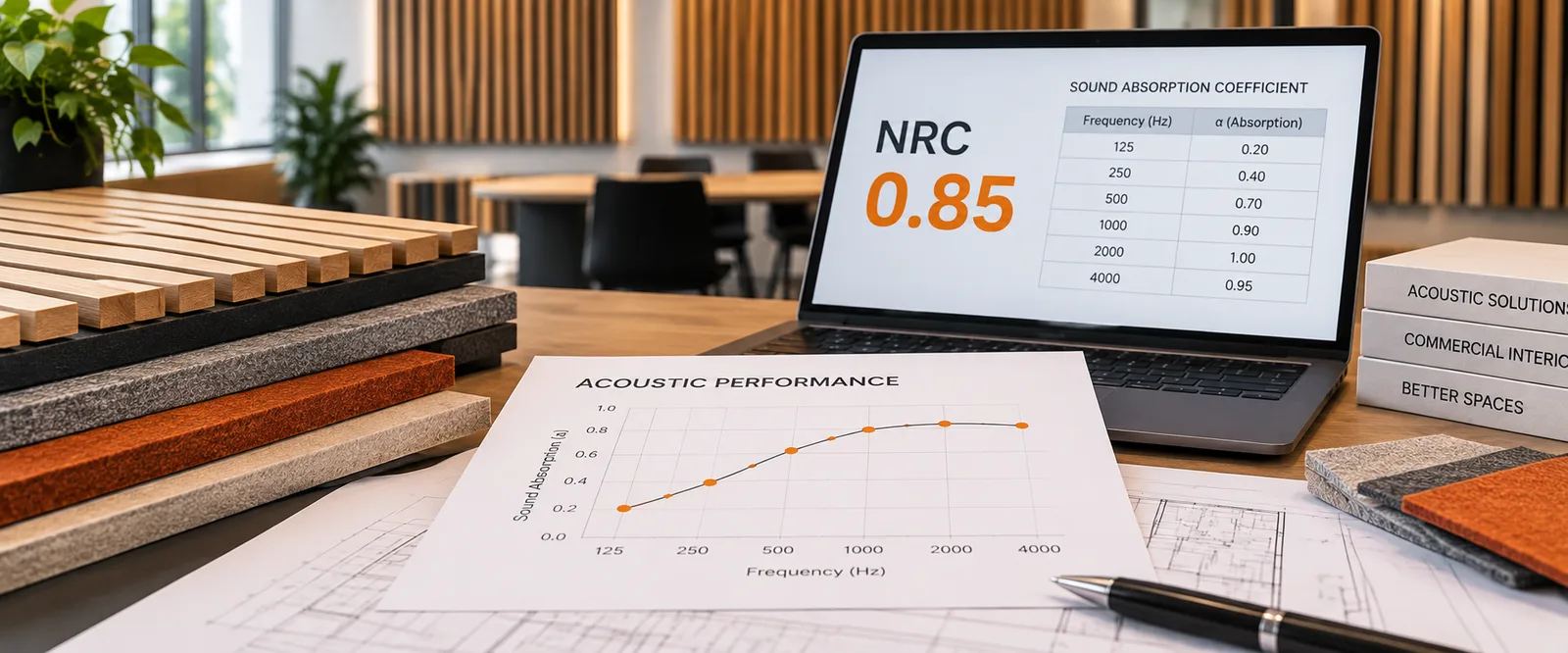
For architects, interior designers, builders and acoustic consultants, the Noise Reduction Coefficient (NRC) is often used as a quick way to compare sound-absorbing products. A panel rated NRC 0.85 may appear to be “better” than one rated NRC 0.75, and on a simple product comparison that can seem like the obvious conclusion.
But NRC is only a summary number.
It tells you something useful about a product’s overall sound absorption, but it does not show you how that product performs across different frequencies, how it was mounted during testing, or whether the test configuration matches the way the product will actually be installed in your project.
For straightforward applications, NRC can be a useful starting point. For more demanding commercial spaces, relying on NRC alone can lead to poor specification decisions.
This guide explains what NRC actually measures, how it is calculated, what information it hides, and what additional data you should ask for when acoustic performance really matters.
What Does NRC Measure?
NRC stands for Noise Reduction Coefficient.
It is a single-number rating used to describe the average sound absorption performance of a material across a selected range of frequencies.
In simple terms, NRC gives an indication of how much sound energy a material absorbs rather than reflects.
An NRC of:
- 0.00 means almost no sound absorption
- 0.50 means roughly half the sound energy is absorbed across the tested range
- 1.00 means very high sound absorption across the tested range
The number is useful because it gives specifiers a quick way to compare different acoustic products.
However, it is important to understand that NRC is not a direct measure of how quiet a room will become.
It does not tell you:
- How much reverberation time will drop
- How much speech clarity will improve
- How much noise will be reduced in decibels
- How well the product performs at every frequency
- How the product will perform in a different mounting condition
Those outcomes depend on the entire room, including its size, finishes, occupancy, product coverage and installation method.
How Is NRC Tested?
Acoustic absorption products are tested in a reverberation chamber under controlled laboratory conditions.
The basic process is straightforward.
First, the reverberation time of the empty chamber is measured.
Then the test product is installed in the chamber in a defined mounting configuration.
The reverberation time is measured again.
The difference between the two measurements is used to calculate how much sound energy the test specimen absorbs.
The result is expressed as a sound absorption coefficient at different frequencies.
These individual absorption coefficients are then used to calculate the NRC value.
The key point is that NRC is not measured directly.
It is derived from a set of frequency-specific test results.
The Four Frequency Bands That Drive the NRC Number
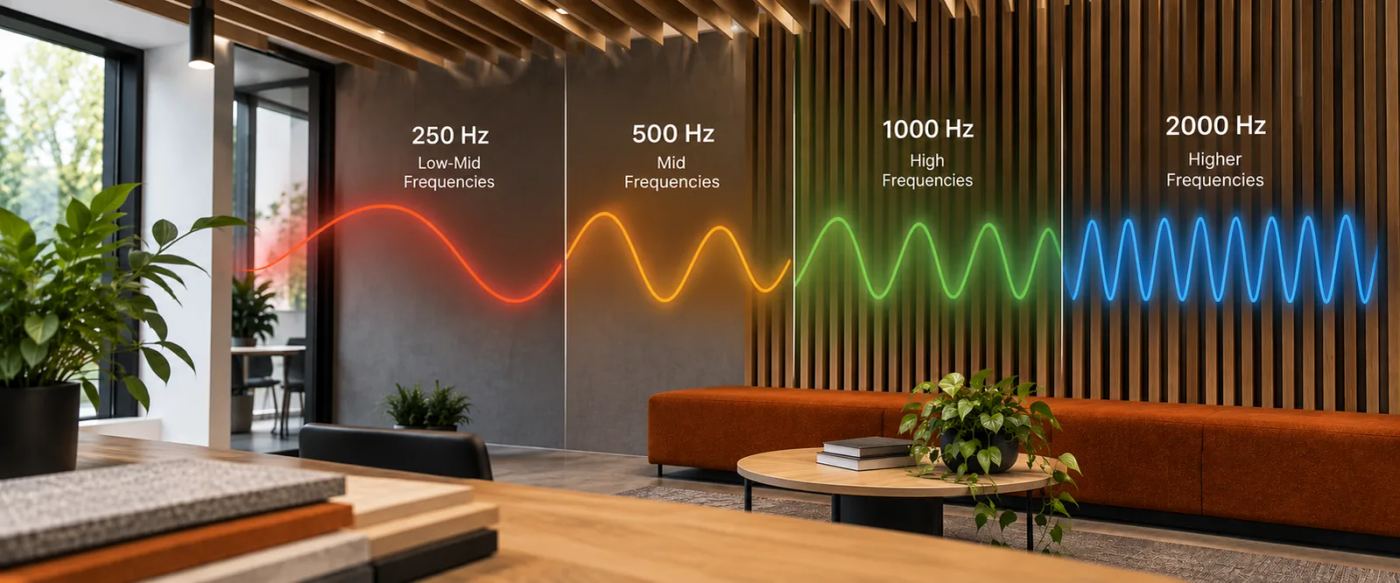
The NRC value is typically calculated from four mid-frequency absorption coefficients:
- 250 Hz
- 500 Hz
- 1000 Hz
- 2000 Hz
These values are averaged and then rounded according to the relevant test method.
This means a single NRC number is really a summary of performance across these four frequency bands.
For example, imagine a product has the following absorption values:
- 250 Hz: 0.55
- 500 Hz: 0.80
- 1000 Hz: 0.95
- 2000 Hz: 0.95
The average is strong overall, so the resulting NRC will also be high.
But another product might achieve the same NRC using a very different performance profile.
For example:
- 250 Hz: 0.80
- 500 Hz: 0.80
- 1000 Hz: 0.85
- 2000 Hz: 0.80
The headline NRC might look similar, but the two products behave differently across the frequency spectrum.
That difference can matter significantly depending on the room and its intended use.
Why an NRC of 0.85 Is Not Always Better Than an NRC of 0.75
This is where NRC is most commonly misread.
A higher NRC does not automatically mean a product is the better choice for every project.
Imagine two acoustic panels:
Panel ANRC 0.85
Panel BNRC 0.75
At first glance, Panel A appears superior.
But if Panel A performs very well at 1000 Hz and 2000 Hz while providing relatively limited absorption at lower frequencies, it may not address the acoustic problem in your room as effectively as Panel B.
Panel B might have a slightly lower average NRC but provide more balanced absorption across the frequencies that matter for your application.
The correct product depends on the sound you are trying to control.
For example:
- Speech-heavy offices often need strong mid-frequency absorption
- Hospitality spaces may need broad-spectrum control
- Larger rooms can benefit from stronger lower-frequency performance
- Meeting rooms may require a balanced response to support speech clarity
NRC simplifies all of this into one number.
That makes it useful for comparison, but dangerous when treated as the only performance metric.
The Information NRC Hides: Octave Band Performance
When the acoustic outcome is important, one of the most useful pieces of information on a specification sheet is the octave band absorption data.
Instead of looking only at the NRC number, review how the product performs at individual frequencies.
Typical octave or one-third-octave data might show values at frequencies such as:
- 125 Hz
- 250 Hz
- 500 Hz
- 1000 Hz
- 2000 Hz
- 4000 Hz
This information gives a much clearer picture of the product’s actual acoustic behaviour.
For example, a panel might perform exceptionally well at speech frequencies but provide limited absorption at 125 Hz.
Another panel may show more even absorption across the spectrum.
Neither product is automatically better.
The correct choice depends on the room.
This is why serious acoustic specifications should consider the full test data rather than relying exclusively on the NRC headline.
What Is a Sound Absorption Coefficient?
The sound absorption coefficient describes the proportion of sound energy absorbed by a surface at a particular frequency.
A coefficient of:
- 0.20 means relatively little absorption
- 0.50 means moderate absorption
- 0.90 means very high absorption
Unlike NRC, which is a single averaged number, the absorption coefficient tells you what is happening at a specific frequency.
This is particularly useful when an acoustic consultant is modelling reverberation time.
Rather than entering one generic NRC value into the model, the consultant can use octave band coefficients to predict how the room will perform across the frequency spectrum.
This produces a much more useful result.
Mounting Condition, Air Gap and the Test-vs-Reality Gap
Another major limitation of NRC is that the result depends heavily on how the product was installed during testing.
Acoustic panels do not perform the same way in every mounting configuration.
Factors that influence absorption include:
- Panel thickness
- Density
- Substrate
- Air gap behind the panel
- Mounting system
- Surface coverage
- Panel orientation
An acoustic panel installed directly against a rigid wall may perform differently from the same panel installed with an air cavity behind it.
In many cases, adding an air gap improves lower-frequency absorption.
This means the same product can have different acoustic performance depending on how it is mounted.
When reviewing a specification sheet, always check the mounting condition used during testing.
If the product was tested with a 100 mm air gap but your project installs it directly against plasterboard, the quoted NRC may not represent the actual installed performance.
This is one of the most common reasons laboratory data and real-world results do not align.
How to Read a Real Acoustic Spec Sheet
A good acoustic specification sheet should give you more than a headline NRC number.
When reviewing a product, look for the following information.
1. NRC Rating
This provides a quick summary of the product’s overall sound absorption.
Use it as a starting point, not the final decision.
2. Frequency-Specific Absorption Data
Look for octave band or one-third-octave band coefficients.
This shows how the product performs across the spectrum.
3. Test Standard
The document should identify the laboratory test method used.
This allows the project team to determine whether the test is relevant and credible.
4. Mounting Configuration
Check whether the product was tested:
- Direct fixed
- Suspended
- With an air gap
- On a specific substrate
This is essential for comparing the test result to the proposed installation.
5. Thickness and Construction
Acoustic performance often changes with panel thickness, density and material composition.
Make sure the test data relates to the exact product being specified.
A Worked Example
Imagine you are comparing two wall panels for an open-plan office.
Panel A
- NRC: 0.85
- 250 Hz: 0.45
- 500 Hz: 0.85
- 1000 Hz: 1.00
- 2000 Hz: 1.00
Panel B
- NRC: 0.80
- 250 Hz: 0.70
- 500 Hz: 0.80
- 1000 Hz: 0.85
- 2000 Hz: 0.85
If you compare NRC only, Panel A appears better.
But Panel B provides stronger absorption at 250 Hz and a more even response across the tested range.
Depending on the office volume, ceiling height and dominant noise sources, Panel B may actually produce a better acoustic result.
The lesson is simple:
NRC tells you how much absorption a product provides on average. Octave band data tells you where that absorption occurs.
Two Questions to Ask Suppliers When NRC Is All They Offer

If a supplier provides only an NRC number, ask these two questions.
1. Can You Provide the Full Frequency Absorption Data?
A reputable acoustic product supplier should be able to provide more detailed test information.
Ask for:
- Octave band coefficients
- Test report
- Product thickness
- Tested mounting condition
This helps you determine whether the product is suitable for the project rather than relying on marketing claims.
2. Does the Test Configuration Match My Installation?
Ask how the product was mounted during testing.
If the laboratory arrangement is significantly different from the project installation, the test result may overstate or understate the real-world performance.
This is particularly important for:
- Ceiling rafts
- Suspended baffles
- Direct-fixed wall panels
- Panels installed over battens
- Products with significant air cavities
NRC Is Useful — But It Is Not the Whole Specification
NRC remains a valuable tool.
It gives architects and designers a quick way to understand whether a material is broadly absorptive and to compare products at an early stage.
The problem arises when NRC becomes the entire acoustic specification.
A serious acoustic assessment should consider:
- Octave band absorption
- Room dimensions
- Product coverage
- Installation method
- Air gaps
- Existing finishes
- Reverberation targets
- Intended use of the space
A product with an impressive NRC value cannot compensate for poor placement, insufficient coverage or the wrong acoustic strategy.
Likewise, a slightly lower NRC product may perform exceptionally well when it is matched correctly to the room.
Why Choose Acoustic Panels Australia?

Acoustic Panels Australia works with architects, interior designers, builders and acoustic consultants to help specify products based on actual performance rather than a single headline number.
Our Australian-made acoustic products are supported by technical performance information that helps project teams evaluate absorption across the frequencies relevant to their application.
Where a project requires more detailed analysis, our team can provide product data to support reverberation calculations, acoustic modelling and consultant specifications.
Whether you are comparing wall panels, ceiling products, baffles or architectural acoustic systems, the goal should always be the same: choose the product based on the acoustic outcome the project needs.
Read Beyond the NRC Number
NRC is useful, but it should never be read in isolation.
The number tells you the average sound absorption performance of a product across selected frequencies. It does not tell you how evenly that absorption is distributed, how the product was mounted during testing, or how it will behave in your particular room.
For straightforward projects, NRC can be a helpful comparison tool.
For commercial environments where reverberation, speech clarity and acoustic comfort matter, ask for the full performance data.
Contact Acoustic Panels Australia to discuss the acoustic requirements of your project and specify products based on the performance your space actually needs.