What Is an Acoustic Panel? What It Does, Where It’s Used, and What to Specify
Learn what acoustic panels are, how they absorb sound, where they’re used, and what to look for when specifying them for Australian commercial projects.
Why does a room with beautiful finishes sometimes feel loud, harsh, or difficult to use?
In many commercial interiors, the issue is not always noise coming from outside the room. It is often the way sound behaves inside the room. Hard surfaces such as glass, concrete, plasterboard, tiles, and timber can reflect sound into the space, making conversations harder to follow and the environment more tiring to be in.
That is where acoustic panels come in.
Acoustic panels are commonly specified in offices, schools, hospitality venues, healthcare spaces, community buildings, and other commercial interiors. Yet they are still often misunderstood. One of the most common mistakes is calling them “soundproofing panels”. They are not.
An acoustic panel is designed to absorb sound within a space. It helps reduce echo, reverberation, and excessive sound reflection. It does not usually stop sound from travelling between rooms.
This guide explains what acoustic panels are, how they work, where they are used, and what to look for when specifying them for an Australian commercial project.
What Is an Acoustic Panel?
An acoustic panel is a sound-absorbing product that improves the acoustic comfort of an interior space.
Its main role is to reduce the amount of sound that bounces around a room. When sound hits a hard surface, much of that sound energy reflects into the space. When sound hits an acoustic panel, some of that energy is absorbed instead.
This helps reduce reverberation, which is the lingering sound that remains after someone has spoken, a chair has moved, music has played, or a machine has operated. In rooms with too much reverberation, speech can become less clear, and background noise can build quickly.
In simple terms:
Acoustic panels make a room sound clearer and more controlled.
They are often used to improve:
1. Speech clarity in meeting rooms and classrooms
2. Comfort in restaurants, cafés, and hospitality spaces
3. Focus in open-plan offices
4. Acoustic control in public and shared environments
5. The overall usability of commercial interiors
Acoustic panels are not only technical products. In modern commercial design, they are often part of a space's visual language. They may appear as wall panels, ceiling features, suspended baffles, decorative fins, screens, or custom architectural elements.
How Acoustic Panels Absorb Sound — The Physics, Simplified
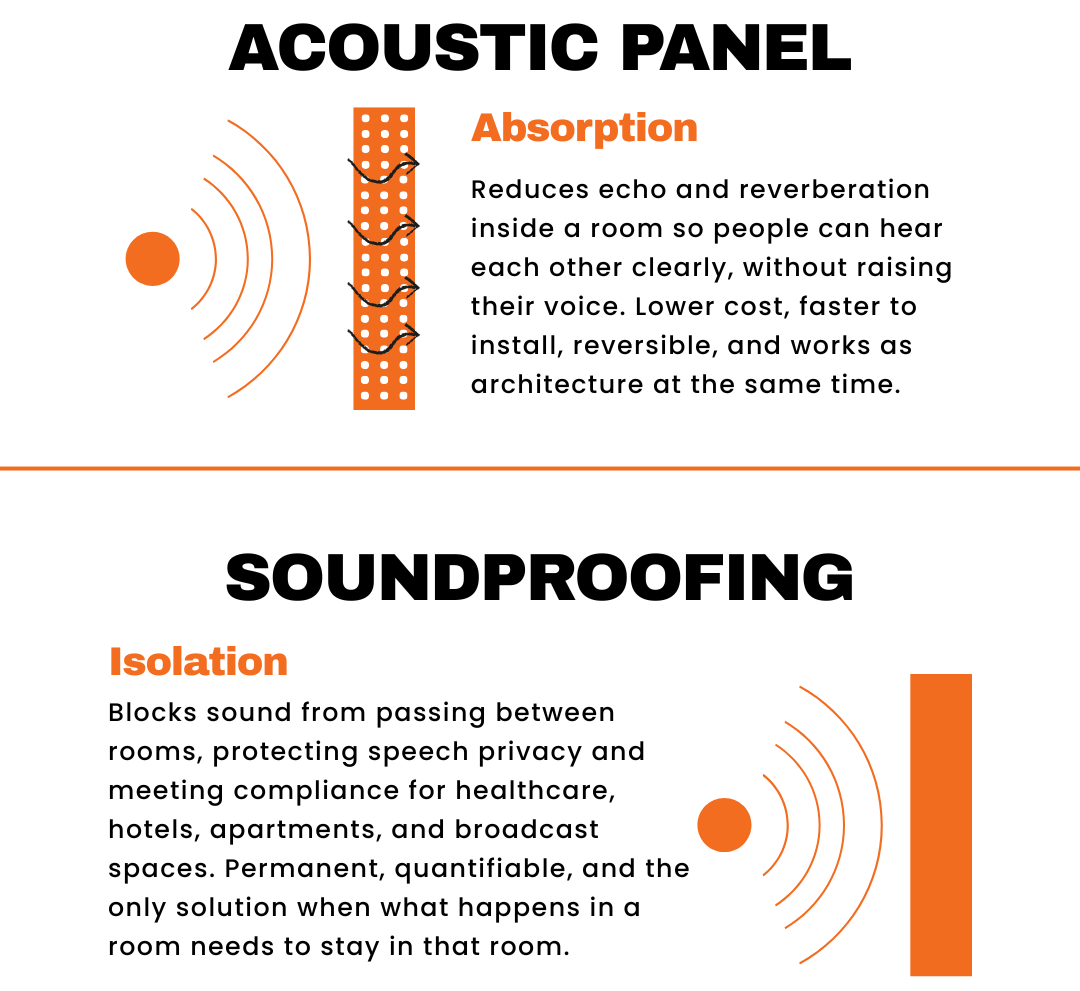
Sound travels in waves. When those waves meet a surface, one of three things can happen: the sound can be reflected, absorbed, or transmitted through the surface.
Hard, dense surfaces usually reflect more sound. Softer or more porous materials can absorb more sound.
Acoustic panels work by allowing sound energy to enter the panel material. Inside the panel, the movement of air particles creates friction against the fibres, pores, or the material's internal structure. This process converts a small amount of sound energy into heat, reducing the amount of sound that reflects into the room.
The result is not silence. The result is control.
A well-treated room still feels active and natural, but it is less harsh, less echoey, and easier to use.
Several factors affect how well an acoustic panel absorbs sound.
Thickness matters because thicker panels can usually absorb a broader range of frequencies. Thin panels may help with higher frequencies, while thicker panels can provide better performance across mid and lower frequencies.
Density and material structure also matter. The material needs to allow sound energy to enter the panel rather than simply bounce off the face.
Installation method can affect performance too. A panel installed with an air gap behind it may perform differently from one fixed directly to a wall or ceiling.
Coverage area is just as important as the panel itself. A small number of panels may not be enough in a highly reflective room. Acoustic performance depends on both the product and how much of it is used in the right locations.
What Acoustic Panels Are Made Of — Materials and Constructions
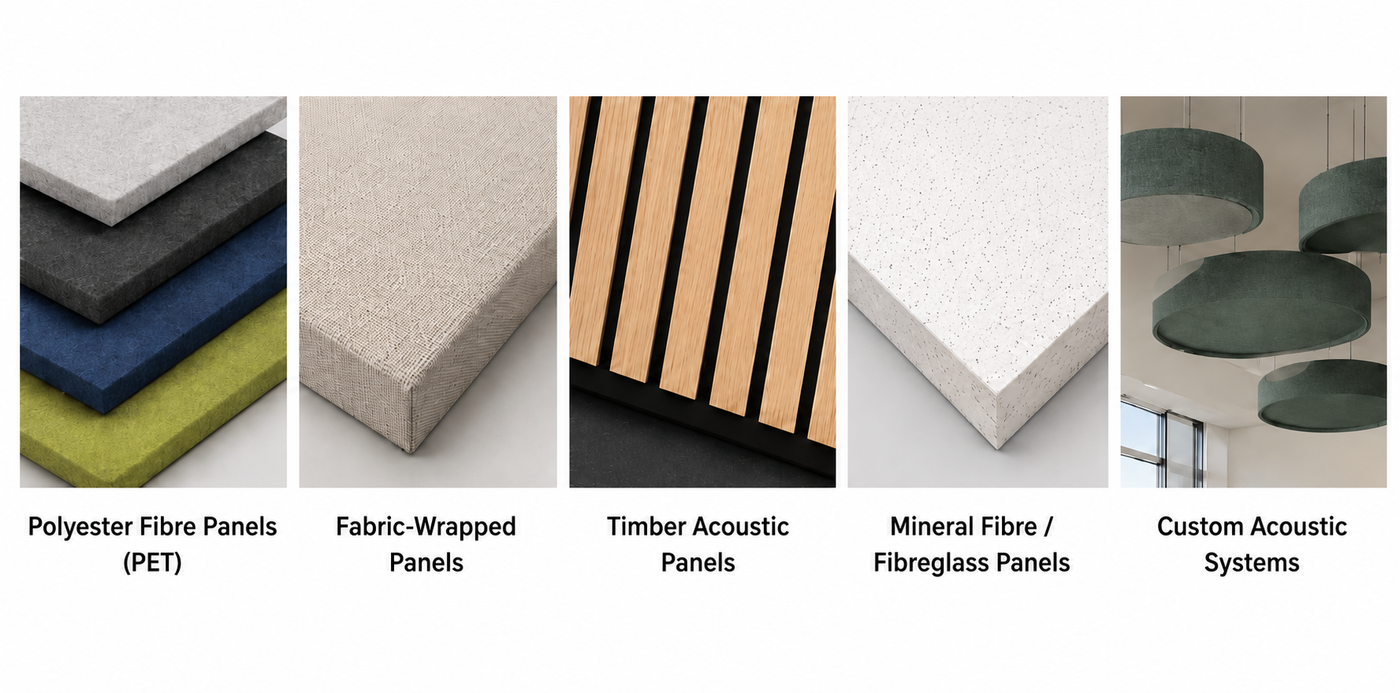
Acoustic panels come in many forms. The right material depends on the project requirements, design intent, performance targets, budget, and compliance needs.
Common acoustic panel materials and constructions include:
Polyester Fibre Panels
Polyester acoustic panels are widely used in commercial interiors because they are lightweight, durable, and versatile. Many are made from PET, including recycled PET content.
They can be cut, shaped, printed, routed, or formed into different design features. This makes them suitable for offices, education spaces, hospitality venues, public buildings, and other commercial environments where acoustic performance and appearance both matter.
Fabric-Wrapped Panels
Fabric-wrapped acoustic panels usually include an absorbent core covered with a decorative textile. These panels are often used where a softer, more tailored finish is required.
They are common in boardrooms, meeting rooms, auditoriums, reception areas, and premium workplace interiors.
Timber Acoustic Panels
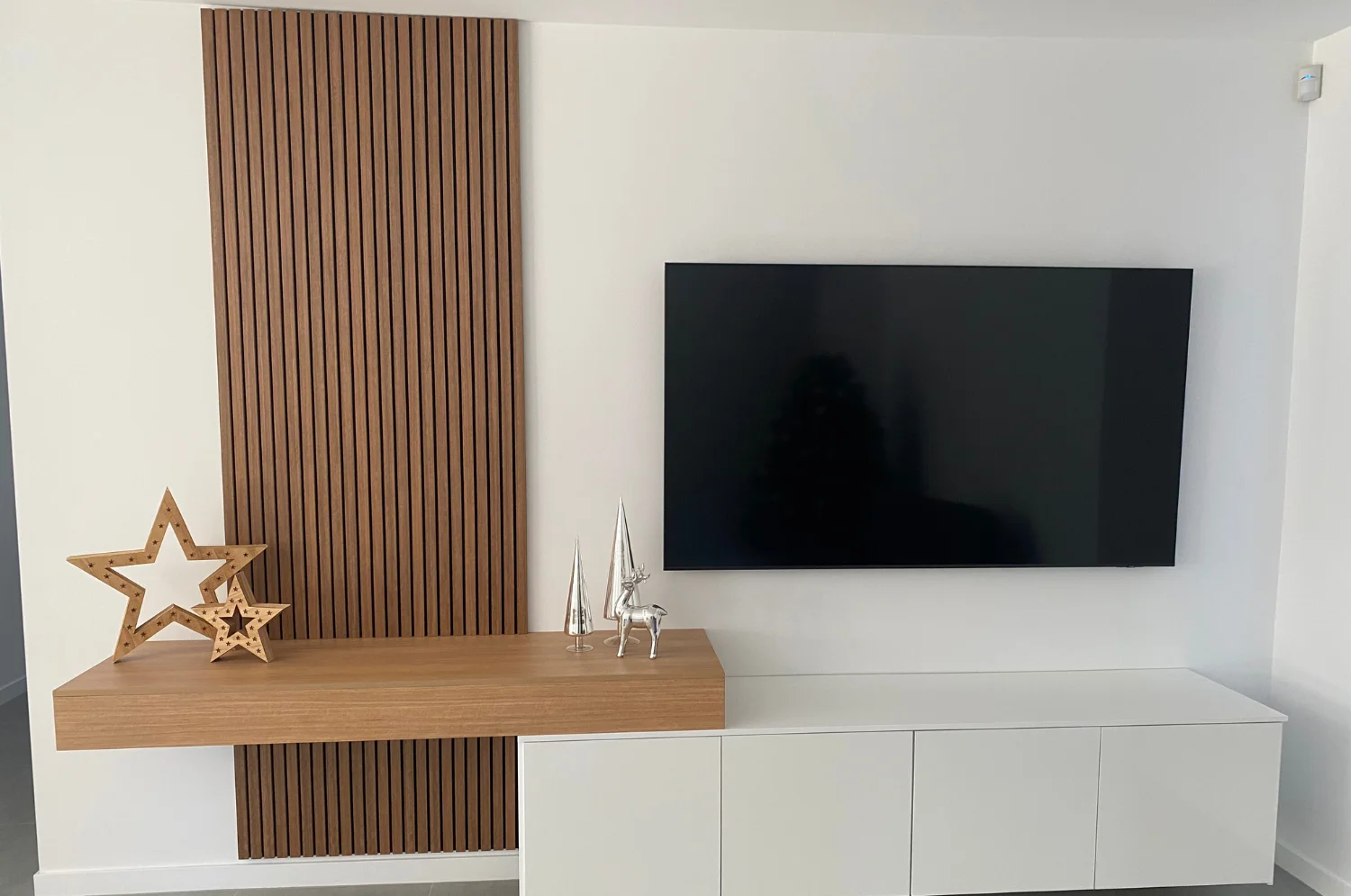
Timber acoustic panels are often used when designers want a warmer architectural finish. These systems may include slotted or perforated timber faces with acoustic backing behind them.
They are often chosen for commercial spaces where the acoustic solution needs to feel integrated into the interior design rather than added on later.
Mineral Fibre and Fibreglass Panels
Mineral fibre and fibreglass products are common in ceiling systems and other technical acoustic applications. They can offer high levels of absorption, depending on their construction and installation.
These products are often used where performance requirements are a priority and where the panels are incorporated into ceiling grids or concealed systems.
Custom Acoustic Systems
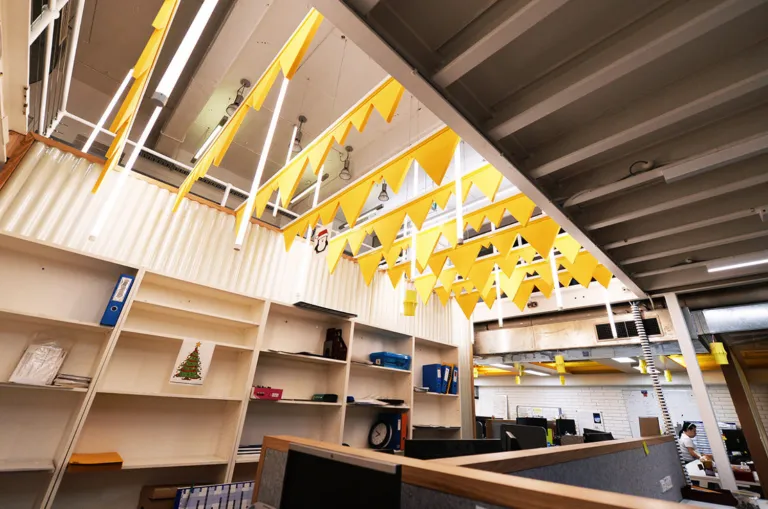
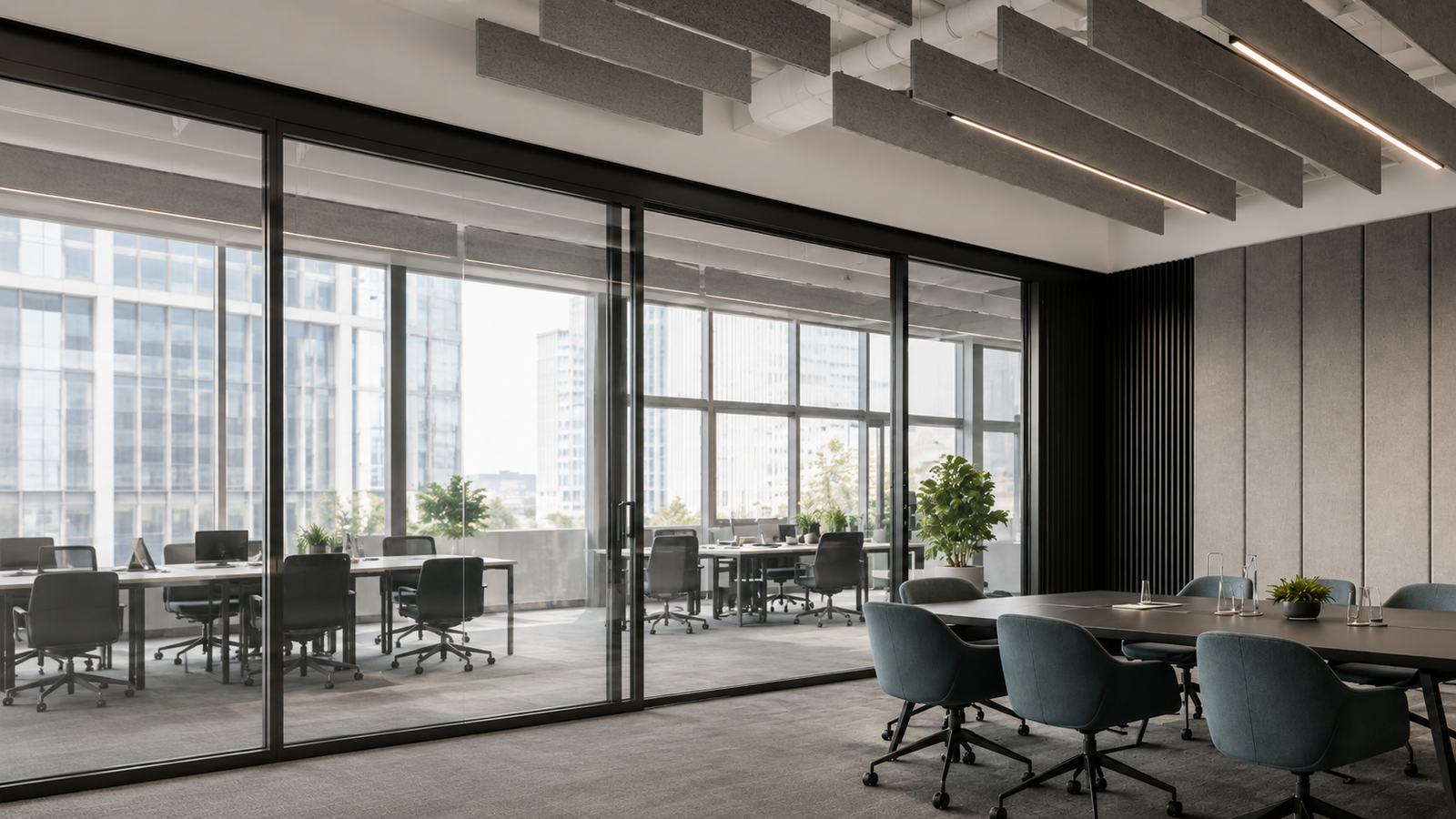
Many commercial projects now use acoustic products as architectural features. This can include ceiling rafts, suspended baffles, fins, wall systems, screens, and three-dimensional forms.
In these cases, the product is doing two jobs. It is improving sound quality while also contributing to the design of the space.
Where Acoustic Panels Live in a Building
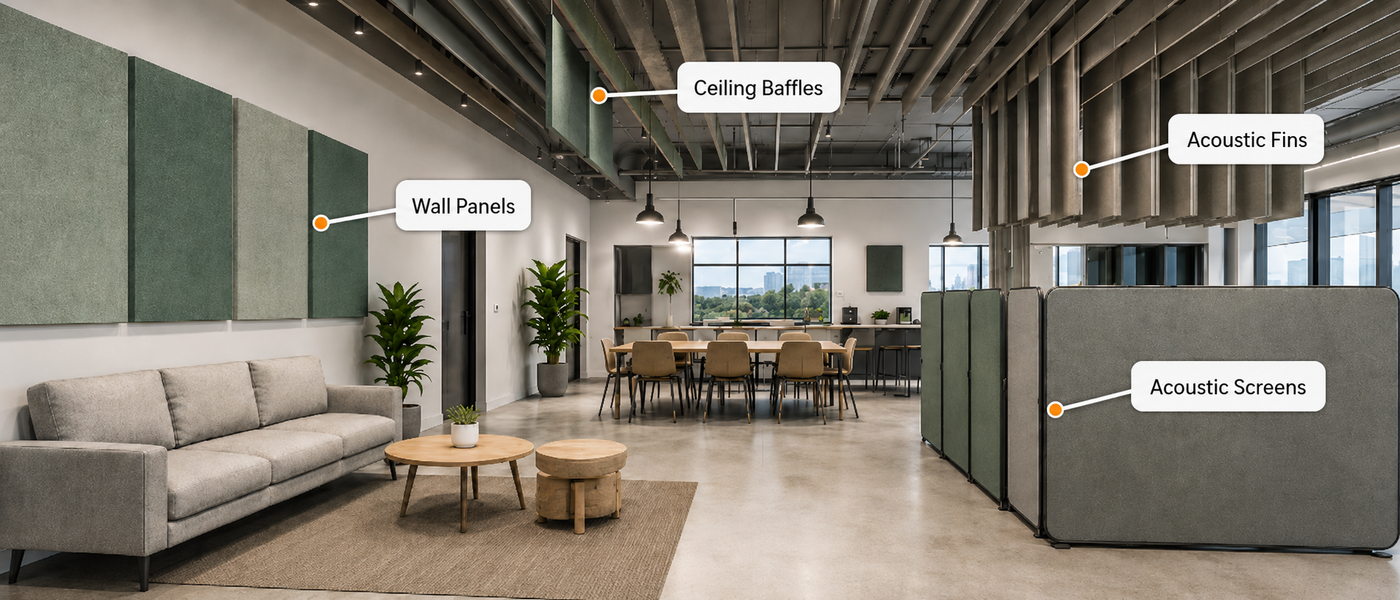
Acoustic panels can be installed in several areas of a building. The best location depends on how the room is used, where sound reflections are occurring, and what surfaces are available.
Wall Panels
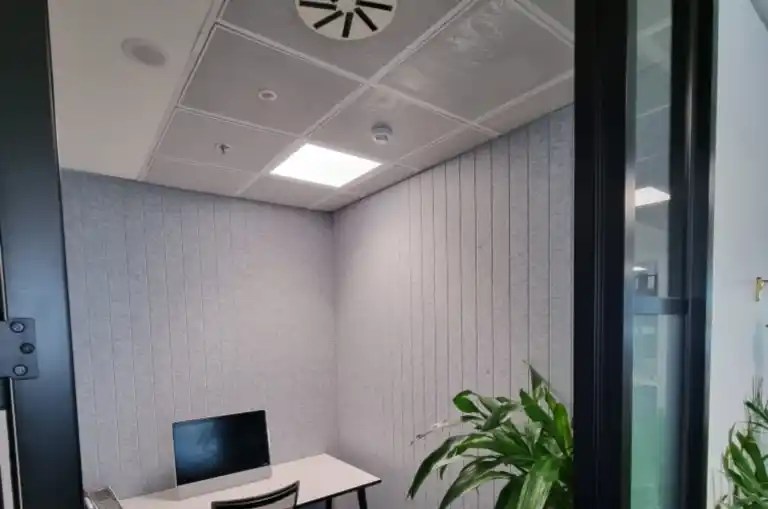
Wall-mounted acoustic panels are one of the most common solutions. They are often used in meeting rooms, classrooms, offices, studios, restaurants, and shared spaces.
Walls are useful treatment areas because they are often close to the source of sound and to the people using the space. In rooms where speech clarity matters, wall panels can help control reflections that interfere with conversation.
Ceiling Panels
Ceilings are often the largest available surface in a room. This makes them highly effective for acoustic treatment, especially in spaces with limited wall area.
Ceiling-mounted acoustic panels, rafts, and clouds are commonly used in offices, education spaces, healthcare settings, hospitality venues, and public interiors.
Acoustic Baffles
Baffles are suspended vertically from the ceiling. They are useful in large spaces, high-ceiling environments, or areas where horizontal ceiling panels may not be suitable.
Because both sides of a baffle can absorb sound, they can provide efficient acoustic coverage while also creating visual rhythm across a ceiling plane.
Acoustic Fins
Fins are often used as a more architectural version of baffles. They can help manage sound while also adding depth, movement, and direction to a space.
They are commonly used in commercial interiors where the acoustic treatment needs to feel like part of the design concept.
Screens and Partitions
Acoustic screens can help reduce localised sound reflections and provide some visual separation in open-plan environments. They are not a full replacement for proper room acoustic design, but they can support better comfort in flexible workplaces and shared settings.
What Acoustic Panels Don’t Do And Where Soundproofing Belongs Instead
The biggest misconception about acoustic panels is that they provide soundproofing.
They usually do not.
Acoustic panels are designed to absorb sound inside a room. Soundproofing is about stopping sound from travelling from one space to another.
That difference matters.
If a meeting room is echoey and voices are difficult to hear clearly, acoustic panels may be part of the solution.
If conversations from that meeting room can be heard in the office next door, the problem is more likely related to sound isolation. That may require changes to walls, doors, ceilings, glazing, seals, or construction details.
Soundproofing is typically handled through building elements such as:
1. Wall and ceiling assemblies
2. Insulation inside cavities
3. Acoustic-rated plasterboard systems
4. Sealed doors and door frames
5. Acoustic glazing
6. Floor and ceiling isolation
7. Junction and penetration detailing
A simple way to separate the two is this:
Acoustic panels control sound within a room.
Soundproofing controls sound transfer between rooms.
Getting this distinction right early can prevent the wrong product from being specified for the wrong problem.
How to Recognise a Well-Specified Panel in a Commercial Brief
A well-specified acoustic panel is not chosen on appearance alone. It needs to suit the space, meet the performance requirements, comply with the project brief, and work with the design.
When reviewing an acoustic panel for a commercial project, look for the following.
Clear Acoustic Performance Data
A good specification should include tested acoustic performance data. Avoid relying only on general claims such as “improves acoustics” or “reduces noise”.
Look for information such as absorption ratings, test conditions, panel thickness, and mounting method. These details help the design team understand how the product is likely to perform in the actual space.
Correct Application
The same product will not suit every environment. A boardroom, classroom, restaurant, corridor, and airport lounge all have different acoustic needs.
The panel should match the room type, occupancy, expected noise levels, and design intent.
Appropriate Fire Performance
For Australian commercial projects, fire performance is an important part of product selection. The required rating will depend on the project type, location, and building requirements.
Always check that the product documentation supports the needs of the specific project.
Durability and Maintenance
Commercial interiors need products that can handle real use. In schools, public spaces, hospitality venues, and workplace environments, panels may be exposed to impact, dust, cleaning, or frequent contact.
A good specification considers how the panel will look and perform over time.
Design Flexibility
Acoustic products are often visible. Colour, shape, edge detail, mounting method, finish, and integration with lighting or services can all affect the final result.
The best acoustic panels do not look like an afterthought. They work with the space's architecture.
Sustainability Considerations
Sustainability is increasingly important in commercial specifications. Depending on the project, it may be useful to consider recycled content, low-emission materials, product lifecycle, local availability, and end-of-life options.
Sustainability should be supported by documentation rather than broad claims.
Acoustic panels are sound-absorbing products used to improve the way a room feels and functions.
They reduce sound reflections, control reverberation, and support better speech clarity. They are commonly used on walls, and ceilings, as baffles, fins, screens, and integrated architectural features across commercial interiors.
They are not the same as soundproofing.
If the issues are echo, harshness, or poor clarity in a room, acoustic panels may be the right solution. If the issue is sound travelling between rooms, the project likely needs sound isolation measures as part of the building construction.
For commercial projects, the best acoustic panel is not just the one that looks good. It is the one that suits the room, meets the performance requirements, aligns with compliance needs, and supports the design intent.
Need help specifying acoustic panels for a commercial project?
Speak with an acoustic product specialist early in the design process to make sure the selected solution supports the space, the brief, and the people who will use it