Acoustic Panel Materials Compared: Fabric, Timber Slat, PET Felt, MDF
Compare acoustic panel materials including fabric-wrapped panels, timber slat panels, PET felt, perforated MDF, plywood and foam for Australian commercial projects.
Choosing the best acoustic panel material is not about finding one product that works for every project.
There is no universally “best” acoustic panel material. There is only the best material for the brief, the room, the design intent, the compliance requirements and the way the space will be used.
For Australian commercial projects, specifiers often compare fabric-wrapped panels, timber slat panels, PET felt, perforated MDF or plywood, and foam. Each material has strengths. Each also has limitations. A material that works beautifully in a boardroom may be the wrong choice for a school corridor. A panel that looks impressive in a hospitality venue may not provide the same acoustic value in an open-plan office. A cost-effective product may become unsuitable if it cannot satisfy the required fire performance, durability or installation conditions.
This guide compares the main acoustic panel materials used in commercial interiors, with practical notes on performance, aesthetics, durability, fire compliance and typical use cases.
The goal is simple: to help you specify acoustic panels on purpose, rather than by default.
The five main material categories
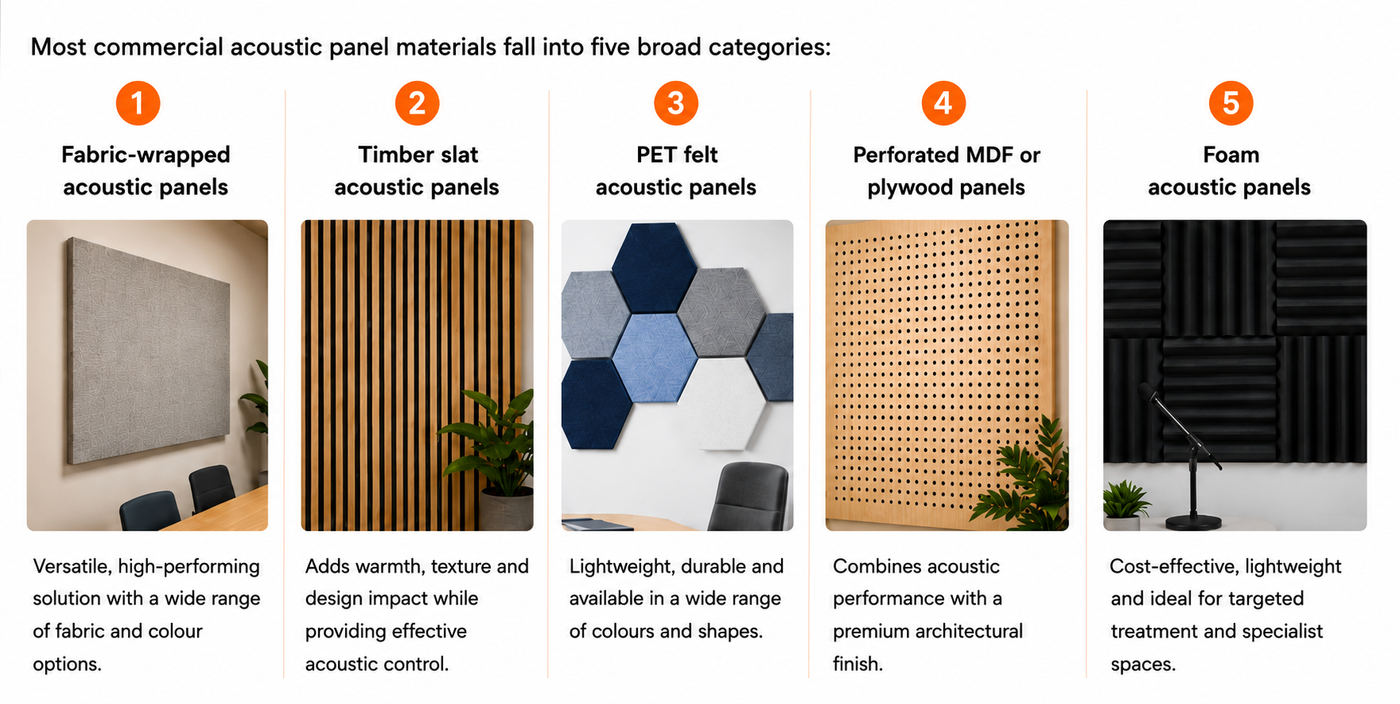
Most commercial acoustic panel materials fall into five broad categories:
- Fabric-wrapped acoustic panels
- Timber slat acoustic panels
- PET felt acoustic panels
- Perforated MDF or plywood acoustic panels
- Foam acoustic panels
Each category can be configured in different ways. Thickness, density, backing material, installation method, air gap, perforation pattern, fabric type and mounting location all affect performance.
This is why material alone does not tell the whole story. A fabric-wrapped panel may perform differently depending on the absorber core. A timber slat panel may offer excellent absorption when backed with the right acoustic material, but much less control if used mainly as a decorative surface. A PET felt panel may be ideal in a lightweight workspace application, but may not suit every impact, fire or finish requirement.
When comparing materials, specifiers should consider five questions:
What acoustic outcome is required?
Is the goal to reduce reverberation, improve speech clarity, control workplace noise or soften a hospitality interior?
What visual outcome is required?
Should the treatment disappear into the design or become a feature?
How durable does it need to be?
Will the panel be installed in a meeting room, school, corridor, public area or high-contact environment?
What compliance requirements apply?
Does the project require specific fire ratings, documentation or certification?
How flexible does the finish need to be?
Does the design require custom colour, printed graphics, timber-look finishes, shaped panels or integrated branding?
With those questions in mind, let’s compare the major material types.
Fabric-wrapped panels: strengths and use cases
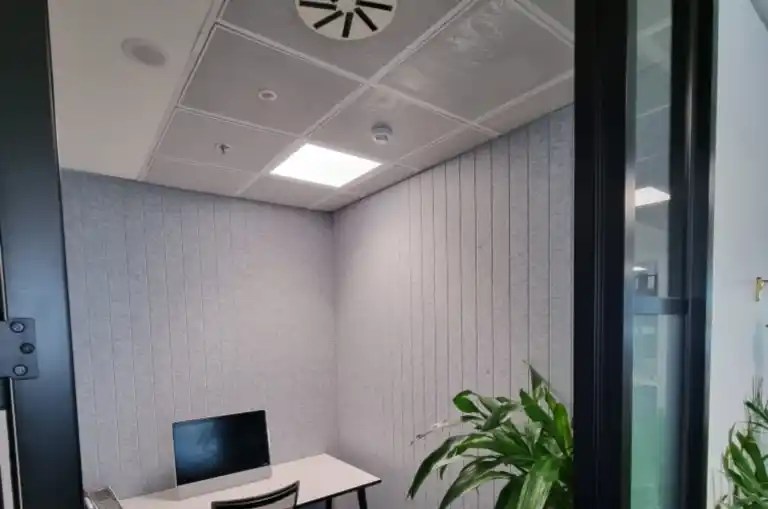
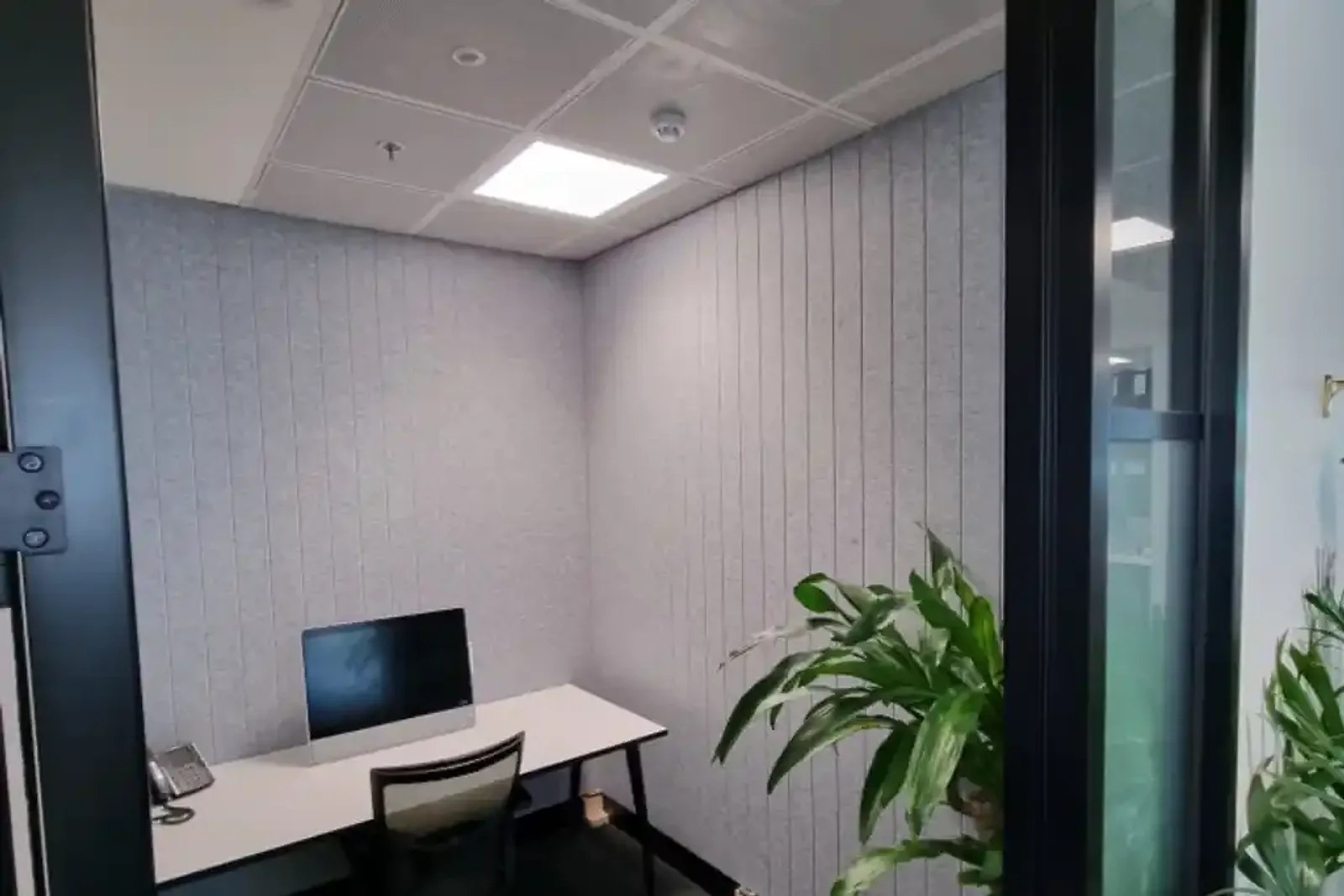
Fabric-wrapped acoustic panels are one of the most versatile options for commercial interiors. They typically consist of an acoustic absorber core covered with a fabric finish, creating a clean and professional appearance.
Their biggest strength is flexibility. Fabric-wrapped panels can suit offices, meeting rooms, education spaces, healthcare environments, libraries, studios, reception areas and boardrooms. They can be wall-mounted, ceiling-mounted or integrated into more customised layouts.
From an acoustic perspective, fabric-wrapped panels are commonly used for reverberation control and speech clarity. They are especially useful in spaces where sound needs to be softened without creating a visually heavy finish.
In meeting rooms, fabric panels can help reduce reflections that interfere with conversation and video calls. In offices, they can be used around focus areas, collaboration zones and shared spaces. In classrooms and training rooms, they can support clearer communication by reducing echo and general sound build-up.
Aesthetic flexibility is another advantage. Fabric options allow specifiers to work with neutral tones, brand colours, textured finishes or more design-led palettes. This makes fabric-wrapped panels suitable for projects where acoustic treatment needs to integrate with the broader interior scheme.
However, fabric panels are not automatically the right choice for every environment. In high-impact areas, fabric may require careful selection to avoid wear, marking or damage. In spaces where cleaning, stain resistance or vandal resistance is critical, the fabric specification should be reviewed closely. The finish also needs to align with fire performance requirements for the project.
Best suited for:
Offices, meeting rooms, boardrooms, classrooms, libraries, healthcare consultation rooms, reception spaces and general commercial interiors.
Main strengths:
Strong acoustic flexibility, broad design options, professional finish, suitable for speech-focused spaces.
Potential limitations:
Fabric durability, stain resistance and fire compliance depend on the selected fabric and panel system.
Timber slat panels: strengths and use cases
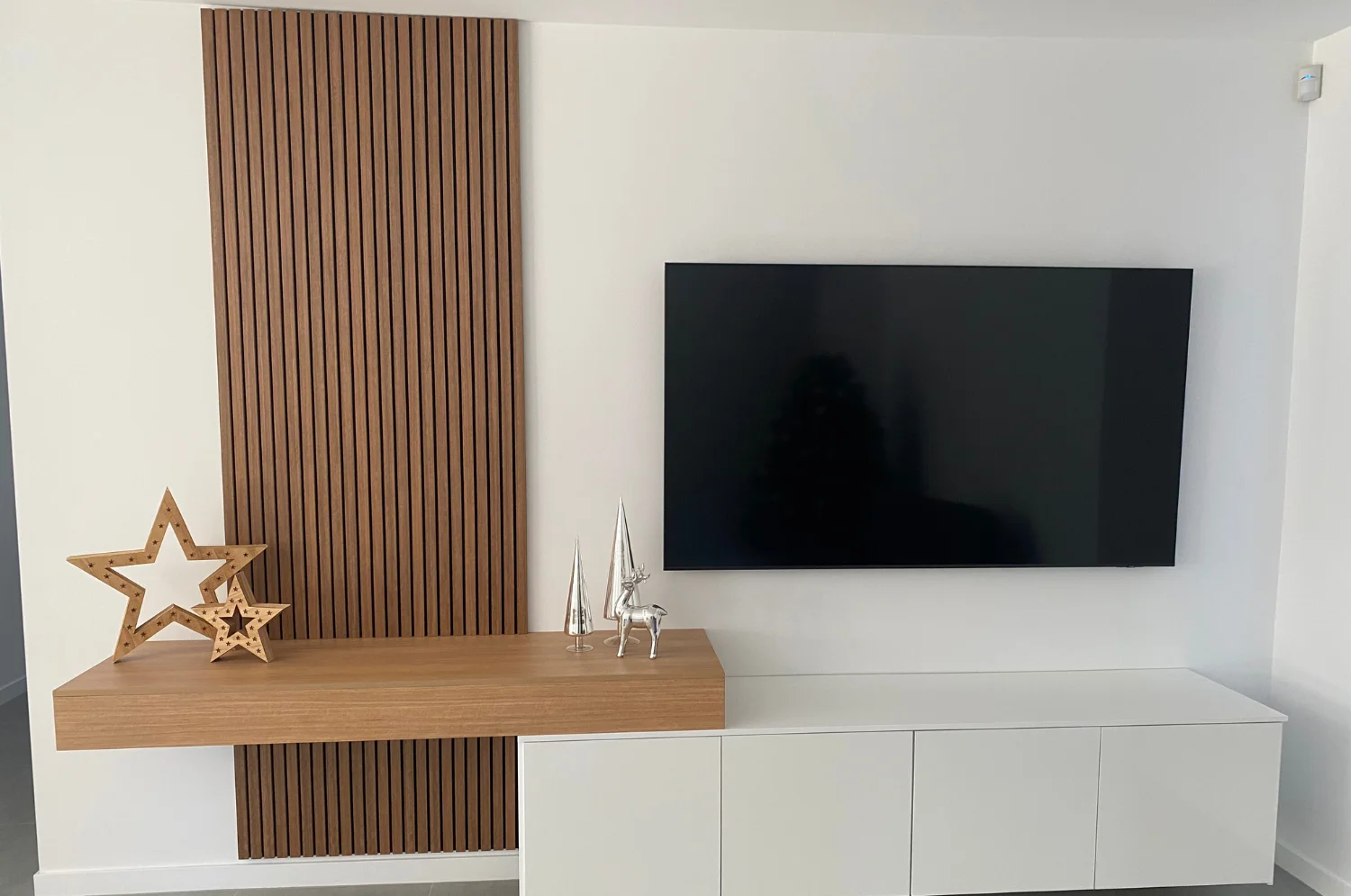
Timber slat acoustic panels have become popular because they combine acoustic function with a strong architectural finish. They are often used when the acoustic treatment is intended to be visible and design-led.
A typical timber slat acoustic system uses timber or timber-look slats over an acoustic backing. The gaps between the slats allow sound to pass through to the absorptive layer behind. This means the acoustic backing is critical. Without the right backing, a slatted panel may behave more like a decorative lining than a meaningful acoustic treatment.
Timber slat panels are especially effective in hospitality spaces, reception areas, boardrooms, corridors, workplace lounges and high-end commercial interiors. They add warmth, rhythm and texture while contributing to reverberation control.
Their main advantage is aesthetic impact. Timber slat panels can make acoustic treatment feel intentional rather than added after the fact. They are well suited to spaces where the interior design needs a premium, natural or architectural feel.
They can also help with durability, depending on the material and finish. Compared with softer surface treatments, timber slat systems may be more suitable for some high-contact areas. However, they can also be more complex to detail, particularly around edges, services, corners and curved surfaces.
The key limitation is that not all timber slat panels perform equally. Acoustic performance depends on slat spacing, backing material, panel depth, installation method and the amount of coverage. A visually similar product may deliver different results acoustically.
Specifiers should avoid choosing timber slat panels purely for appearance. The system should be reviewed as a complete acoustic assembly.
Best suited for:
Hospitality venues, reception areas, boardrooms, workplace lounges, corridors, feature walls and premium commercial interiors.
Main strengths:
Architectural appearance, warm finish, strong visual impact, can integrate acoustic treatment into the design.
Potential limitations:
Performance depends heavily on the backing and system design. Detailing and fire compliance should be checked carefully.
PET felt panels: strengths and use cases
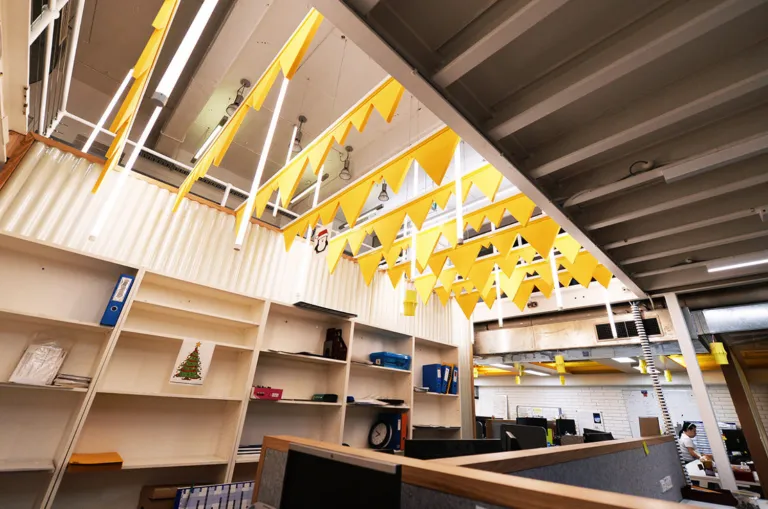
PET felt acoustic panels are widely used in modern commercial interiors because they are lightweight, flexible and available in many colours, shapes and formats.
PET felt is commonly made from polyester fibre, and many PET products include recycled content. This can make PET felt appealing for projects with sustainability goals, although specifiers should always check the specific product documentation rather than assuming all PET panels have the same environmental profile.
PET felt is often used in offices, schools, libraries, breakout areas, meeting rooms and creative workspaces. It can be supplied as wall panels, ceiling features, suspended screens, desk dividers, decorative tiles or custom-cut shapes.
One of PET felt’s major advantages is design flexibility. It can be cut into geometric forms, used for colour blocking, suspended as baffles or installed as lightweight wall treatment. This makes it useful when the acoustic solution needs to be playful, modern or visually integrated into a flexible workspace.
It is also relatively easy to handle and install compared with some heavier systems. For projects with multiple zones or changing layouts, PET felt can be a practical option.
Acoustically, PET felt can help reduce reverberation and soften reflective spaces, especially when installed with adequate coverage and thickness. However, thinner PET products may not provide the same level of broadband absorption as deeper acoustic systems. The installation method matters as well. A panel mounted directly to a hard surface will perform differently from one installed with an air gap or used as a suspended element.
Durability is generally good for many commercial applications, but PET felt may not be right for every high-impact or hygiene-sensitive setting. It can also have limitations where a very premium finish, specific cleanability requirement or strict fire performance requirement is needed.
Best suited for:
Open-plan offices, schools, libraries, creative workplaces, breakout areas, meeting rooms, ceiling features and lightweight acoustic screens.
Main strengths:
Lightweight, flexible, available in many colours, good for custom shapes and modern interiors.
Potential limitations:
Performance varies by thickness and installation. Check fire rating, recycled content claims and suitability for high-contact areas.
Perforated MDF and plywood: strengths and use cases
Perforated MDF and plywood panels are often used where specifiers want a more robust, architectural or joinery-integrated acoustic finish.
These systems typically use a rigid board with perforations, slots or grooves, backed by an acoustic absorber. The openings allow sound to pass through the face material into the absorptive layer behind. Like timber slat systems, the full assembly matters. The face board alone is not the acoustic solution.
Perforated MDF and plywood panels are well suited to lecture theatres, auditoriums, boardrooms, education spaces, libraries, civic interiors, commercial lobbies and public buildings. They can provide a refined finish while allowing acoustic treatment to be integrated into walls, ceilings, joinery or large architectural surfaces.
A major advantage is design control. Perforation patterns, timber veneers, painted finishes, clear coatings and custom layouts can be selected to suit the interior. These systems can feel more permanent and architectural than soft panel products.
They can also be appropriate where a more durable surface is required. In public or high-use spaces, rigid panel systems may offer better resistance to impact than exposed soft finishes, depending on the specification.
However, perforated MDF and plywood systems usually require more detailed coordination. The acoustic backing, cavity depth, perforation percentage, fixing method, edge detailing and fire performance all affect the final result. They may also be less flexible once installed compared with modular fabric or PET panels.
The other consideration is cost and lead time. Custom perforated or veneered systems can be more expensive and may require longer planning, especially for larger commercial projects.
Best suited for:
Auditoriums, lecture theatres, libraries, education spaces, boardrooms, civic interiors, commercial lobbies and architectural wall or ceiling linings.
Main strengths:
Durable, architectural, highly customisable, suitable for integrated wall and ceiling systems.
Potential limitations:
Requires careful detailing. Acoustic performance depends on perforation, backing and installation depth.
Foam panels: why they rarely belong in commercial briefs
Foam acoustic panels are familiar because they are common in home studios and low-cost online acoustic products. However, they rarely belong in serious commercial acoustic briefs.
The issue is not that foam absorbs no sound. Many foam products can absorb some mid and high frequencies. The issue is that commercial projects usually require more than basic absorption. They require durability, cleanability, fire performance, aesthetic quality, documentation and long-term suitability.
Foam panels often struggle in these areas. They can look informal or temporary, which may not suit commercial interiors. They may be vulnerable to damage, dust, discolouration or wear. Most importantly, their fire performance and compliance documentation need very careful review before they are considered for any commercial project.
In offices, schools, hospitality venues and public interiors, foam may create more risk than value. It can also lead to poor acoustic outcomes if it is used as a cheap substitute for a properly specified system. A room may still suffer from low-frequency build-up, poor placement or insufficient coverage even if foam has been added to the walls.
Foam may have a place in certain controlled studio or temporary applications, but for commercial specification, it is usually better to consider fabric-wrapped, PET felt, timber slat or perforated panel systems with appropriate documentation.
Best suited for:
Limited studio or temporary applications, subject to suitability and compliance checks.
Main strengths:
Low cost, lightweight, familiar for small-scale use.
Potential limitations:
Often poor fit for commercial aesthetics, durability and compliance requirements.
Material vs sector: a quick-reference matrix
The best acoustic panel material depends heavily on the sector and the specific project brief. The table below provides a practical starting point.
Sector / Space
Fabric-Wrapped Panels
Timber Slat Panels
PET Felt Panels
Perforated MDF / Plywood
Foam Panels
Open-plan offices
Excellent for focused zones, meeting rooms and general absorption
Good for feature areas and premium zones
Excellent for lightweight screens, walls and ceiling features
Good for integrated architectural areas
Rarely recommended
Meeting rooms
Excellent for speech clarity and video calls
Good if backed correctly
Good for modern, lightweight treatment
Excellent for premium or integrated finishes
Rarely recommended
Classrooms
Excellent for speech intelligibility
Possible, but depends on durability and budget
Good for colourful, lightweight treatment
Good for robust education interiors
Rarely recommended
Hospitality venues
Good for concealed or decorative wall treatment
Excellent for warmth and visual impact
Good for design-led features
Excellent for durable architectural finishes
Rarely recommended
Healthcare spaces
Good if cleanability and fabric selection are suitable
Selectively useful in waiting or reception areas
Possible, subject to hygiene requirements
Good for durable public areas
Rarely recommended
Libraries
Excellent for quiet zones and study rooms
Good for feature walls and reading areas
Good for zones and suspended features
Excellent for integrated interiors
Rarely recommended
Public buildings
Good in controlled areas
Good for feature applications
Useful in selected zones
Excellent for robust architectural treatment
Rarely recommended
This matrix is not a substitute for project-specific acoustic advice, but it helps narrow the material conversation. In many commercial projects, the final solution may combine two or more materials.
For example, an office fit-out may use PET felt baffles over collaboration zones, fabric-wrapped panels in meeting rooms and timber slat panels in reception. A university project may use perforated timber panels in lecture spaces and fabric panels in smaller tutorial rooms.
The right answer is often a system, not a single material.
The fire rating question across materials
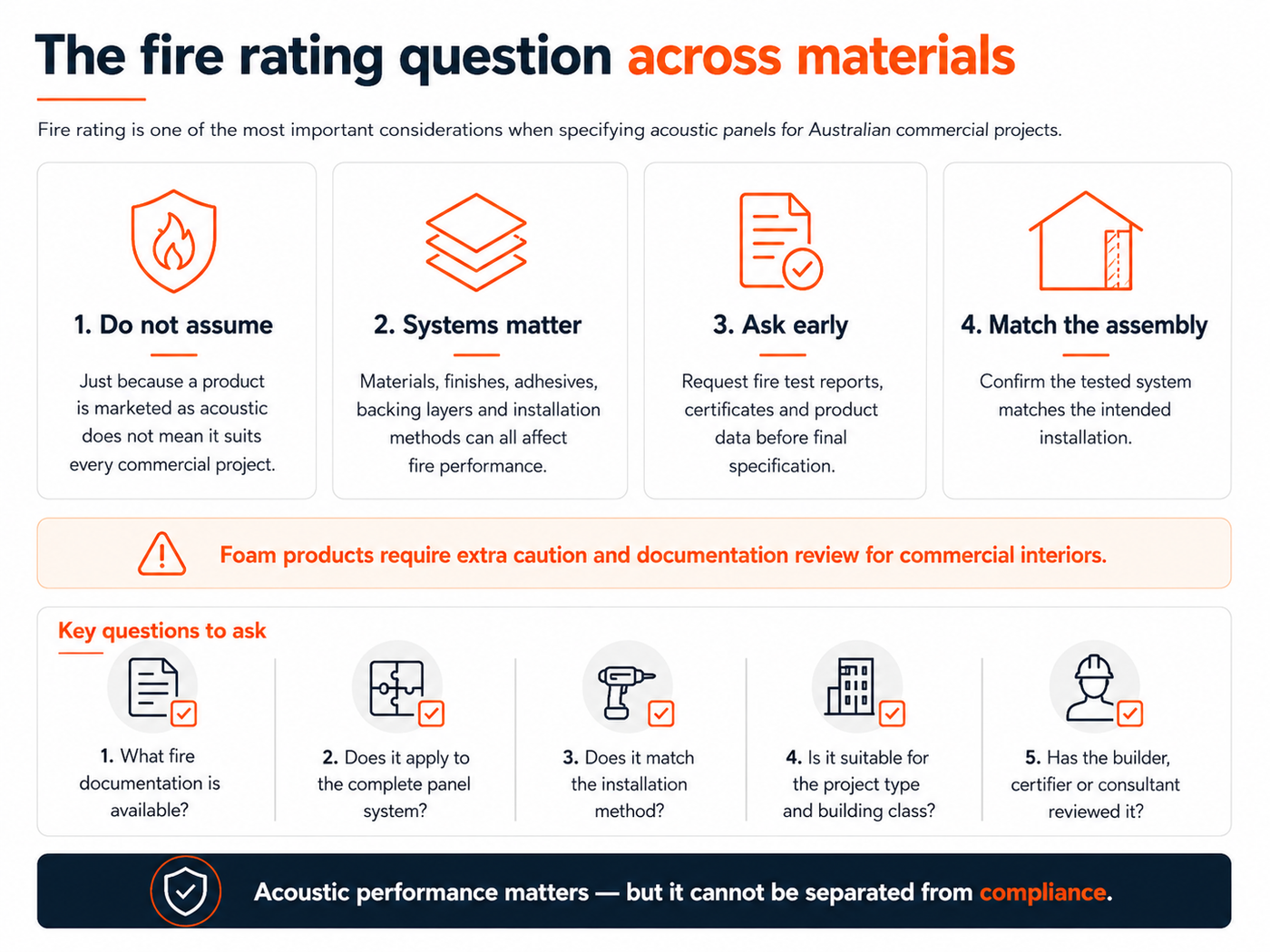
Fire performance is one of the most important considerations when specifying acoustic panels for Australian commercial projects.
It should never be assumed that a product is suitable simply because it is marketed as an acoustic panel. Different materials, finishes, adhesives, backing layers and installation methods can affect fire performance.
This is particularly important when comparing fabric, timber slat, PET felt, MDF, plywood and foam products. Each material category can include products with different fire test results and different documentation. Even within the same category, one panel may be appropriate for a commercial project while another may not be.
Specifiers should request the relevant fire rating documentation early. This may include test reports, certificates, material data sheets and details of how the product was tested. It is also important to confirm whether the tested assembly matches the intended installation.
For example, a panel tested in one configuration may not automatically have the same performance when installed with a different backing, finish, adhesive or air gap. Timber finishes, fabric coverings and acoustic cores should be reviewed as part of the full system.
Foam products require particular caution. Many low-cost foam products may not meet the requirements expected in commercial interiors, or may lack adequate documentation for project approval.
The safest approach is to treat fire rating as a specification requirement, not a late-stage admin task.
Ask early:
What fire performance documentation is available?Does it apply to the complete panel system?Does it match the intended installation method?Is the product suitable for the project type and building class?Has the builder, certifier or acoustic consultant reviewed the documentation?
Acoustic performance matters, but it cannot be separated from compliance.
How custom finishes change the equation
Custom finishes can completely change how acoustic panels are used in a project.
A panel is no longer just a functional absorber. It can become signage, branding, wall lining, artwork, ceiling feature, spatial divider or architectural detail.
This is where material selection becomes more strategic.
Fabric-wrapped panels can support colour matching, textured finishes and printed graphics. PET felt can be cut into shapes, patterns and layered designs. Timber slat panels can introduce warmth and rhythm. Perforated MDF and plywood can be integrated into joinery, wall linings or ceiling systems. Each material gives the designer a different way to make acoustic treatment feel intentional.
Custom finishes are especially useful when acoustics need to be included without making the space look overly technical. In commercial interiors, the best acoustic treatment often feels like part of the design from the beginning.
However, customisation should not compromise performance. Printing on fabric, applying coatings, changing perforation patterns, altering backing materials or using decorative finishes may affect acoustic behaviour or fire performance. These changes should be reviewed before final specification.
A beautiful panel that fails the acoustic brief is still a failed panel. A compliant panel that clashes with the interior may also be rejected late in the process. The best result sits between performance, compliance and design intent.
For specifiers, custom finishes are most successful when acoustic requirements are discussed early. That allows the material, finish, panel size, fixing method and placement strategy to be coordinated before the design is locked in.
Final thoughts
The best acoustic panel material depends on the project.
Fabric-wrapped panels offer broad flexibility and strong performance for speech-focused spaces. Timber slat panels provide warmth and architectural impact when paired with the right acoustic backing. PET felt is lightweight, colourful and flexible for modern commercial interiors. Perforated MDF and plywood provide robust, integrated finishes for more architectural applications. Foam is generally best avoided in commercial briefs unless there is a very specific, controlled use case and suitable compliance documentation.
The most important point is this: material selection should follow the brief.
Before choosing an acoustic panel material, define the acoustic goal, the visual intent, the durability requirements, the installation conditions and the compliance pathway. Once those are clear, the right material becomes much easier to select.
For Australian commercial projects, acoustic panels should never be specified on appearance alone. The strongest outcomes come from combining the right material with the right placement, the right documentation and the right project support.
Need help choosing the right acoustic panel material?
Acoustic Panels Australia can help you compare fabric-wrapped panels, timber slat panels, PET felt and other commercial acoustic solutions for your project. Whether you are specifying for an office, classroom, meeting room, hospitality venue or public interior, our team can help you select a material that suits the acoustic brief, design intent and compliance requirements.
Send us your project brief, floor plan or finish requirements and we’ll help you choose the right acoustic panel material.
Not sure which material suits your brief? Compare the full acoustic panel range or talk to our team about your project requirements.