Cutting Reverberation in a Gym, Auditorium or Community Hall
Learn how acoustic wall and ceiling panels reduce reverberation in gyms, auditoriums and community halls while supporting speech clarity and compliance.
A gym, auditorium and community hall may serve very different purposes, but acoustically they often share the same fundamental challenge.
They are large spaces with high ceilings and extensive hard surfaces.
Concrete, masonry, timber floors, plasterboard, glazing and other durable finishes reflect sound rather than absorb it. Combine those surfaces with a large room volume, and sound can continue travelling around the space long after it was originally produced.
In a gym, that can mean whistles, bouncing balls and voices building into a constant wash of noise.
In an auditorium, excessive reverberation can make presentations and performances less distinct.
In a community hall, the same room may need to handle a meeting in the morning, a school activity in the afternoon and a function in the evening.
The acoustic treatment therefore needs to respond to how the room is actually used.
Adding appropriately selected acoustic wall panels, ceiling panels or suspended acoustic treatments can reduce reflected sound and bring reverberation under control, improving conditions for speech, music and announcements.
Why Do Large Rooms Reverberate So Much?
Reverberation occurs when sound reflects repeatedly from the surfaces of a room instead of being absorbed.
Large halls are particularly susceptible because they often combine three characteristics:
- Large room volume
- High ceilings
- Extensive hard surfaces
When someone speaks, a ball hits the floor or music plays through a loudspeaker, the sound doesn't simply travel to the listener.
It also reaches the walls, floor and ceiling.
Hard surfaces reflect much of that energy back into the room. Those reflections then encounter other surfaces and continue travelling.
The larger and more reflective the room, the longer sound may persist.
This is why an empty gym can sound dramatically different from a carpeted office of the same floor area.
The gym has very little absorption relative to its volume.
Reverberation Is More Than Just "Echo"
People often describe a reverberant hall as having too much echo.
While that description is understandable, the problem is usually more accurately described as excessive reverberation.
A distinct echo is a reflection that arrives late enough to be heard separately from the original sound.
Reverberation is the accumulation of many reflections arriving closely together.
In a large multi-use space, excessive reverberation can affect:
- Speech intelligibility
- PA announcements
- Presentations
- Music
- Sporting instruction
- Group activities
- Overall acoustic comfort
The room may not necessarily sound louder because of one individual noise source. Instead, sound from multiple sources remains in the room and overlaps.
Reducing those reflections is therefore a key part of improving the acoustic environment.
Match the Acoustic Treatment to the Room's Use
A gym, auditorium and community hall shouldn't automatically receive the same acoustic treatment simply because all three are large spaces.
Their priorities are different.
Gymnasiums and Sports Halls
Sports spaces generate frequent high-energy noise.
Common sources include:
- Balls striking floors and walls
- Whistles
- Sporting equipment
- Shouting
- Group instruction
- Spectators
- PA systems
The acoustic treatment needs to control reverberation while also working within a physically demanding environment.
Durability and placement become particularly important.
Auditoriums
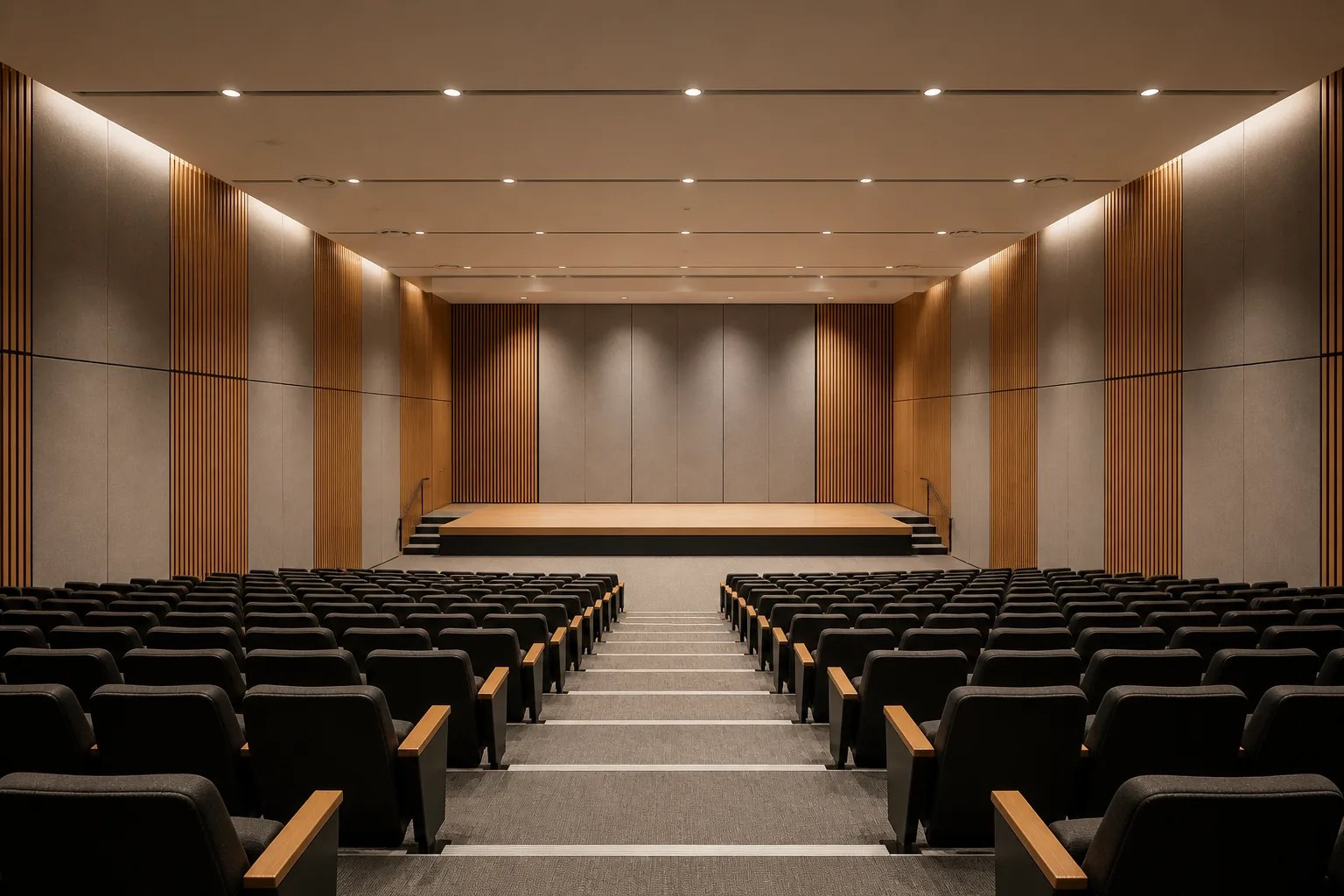
Auditoriums place greater emphasis on communication and performance.
Speech from a stage needs to remain intelligible throughout the audience area, while music may require a different acoustic character from spoken presentations.
The design should therefore consider the auditorium's primary use rather than simply adding as much absorption as possible.
Too much untreated reflection can make speech unclear, but acoustic treatment should still be developed around the intended function of the room.
Community Halls
Community halls can be more challenging because they often serve many purposes.
The same room might host:
- Public meetings
- School activities
- Exercise classes
- Performances
- Community events
- Functions
- Presentations
An acoustic strategy for a multi-use hall should therefore aim for a balanced environment that supports the activities most frequently undertaken in the space.
This is where appropriate reverberation targets become particularly useful.
What Does AS/NZS 2107 Say About Reverberation?
Rather than assuming every large room should have the same acoustic conditions, designers can refer to AS/NZS 2107, which provides guidance for recommended internal acoustic conditions for different types of occupied spaces.
Importantly, recommended reverberation conditions vary according to the room's function.
A space primarily intended for speech has different acoustic priorities from one used for music or sport.
This matters because simply saying:
"We need to reduce the echo"
isn't a complete acoustic brief.
A better question is:
"What reverberation condition is appropriate for the way this particular room will be used?"
Once the required acoustic outcome has been established, the type, quantity and location of acoustic treatment can be considered accordingly.
For projects with more complex acoustic requirements—particularly performance spaces—an acoustic consultant may also be required to develop and verify the design.
How Acoustic Panels Reduce Reverberation
Acoustic panels introduce absorptive surfaces into a room that otherwise contains predominantly reflective finishes.
When sound reaches an appropriate acoustic panel, part of its energy is absorbed rather than being reflected directly back into the space.
As the total amount of absorption increases, the persistence of sound can be reduced.
In large halls, treatment can typically be introduced through:
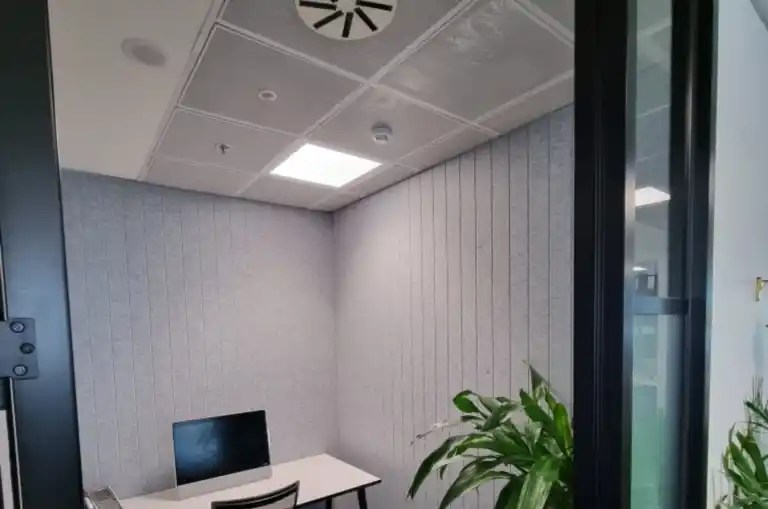
- Acoustic wall panels
- Acoustic ceiling panels
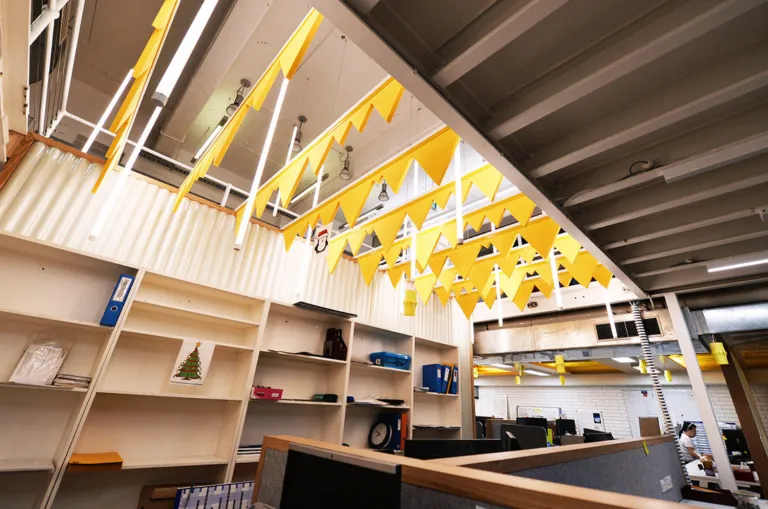
- Suspended acoustic baffles
- Other ceiling-mounted absorptive systems
The appropriate solution depends on the room geometry, available surfaces, services, acoustic requirements and how the space is used.
The key is not simply selecting an acoustic product.
It is providing enough appropriately positioned absorption to influence the room as a whole.
Where Should Acoustic Panels Be Installed?
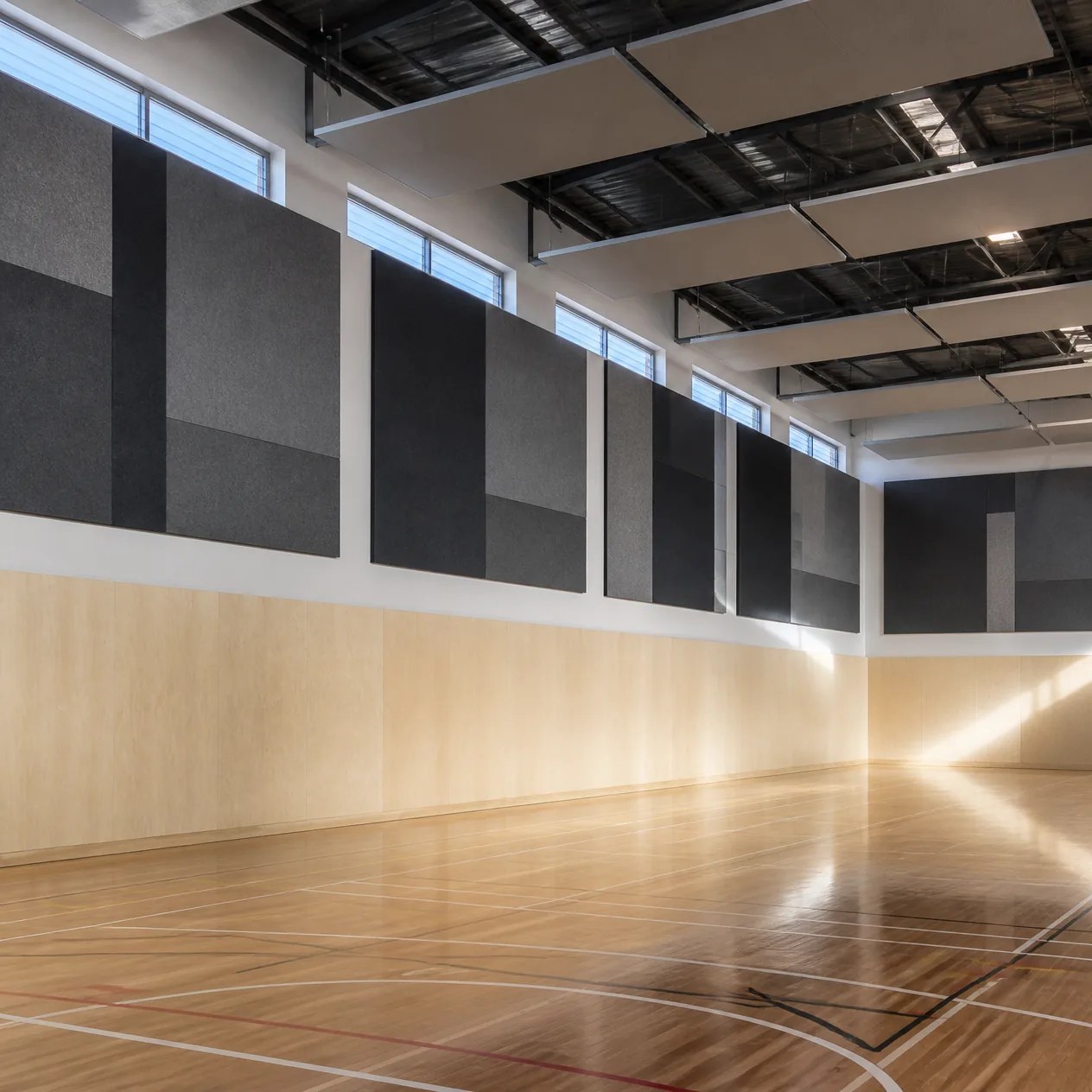
Large spaces usually provide plenty of surface area, but not every part of the room is equally practical for acoustic treatment.
Ceiling Treatment
The ceiling can be one of the most valuable areas for absorption because it often represents a large uninterrupted surface.
Where direct ceiling mounting isn't practical, suspended acoustic baffles can provide another option.
Baffles are particularly useful in spaces with:
- High ceilings
- Exposed structures
- Existing building services
- Limited usable wall area
Because suspended baffles expose multiple surfaces to the room, they can provide effective absorption without requiring a conventional suspended ceiling.
Upper Wall Treatment
Upper wall areas are another useful location, particularly in gyms and sports halls.
Installing treatment above the main impact zone can help introduce absorption while reducing the likelihood of panels being struck by balls, equipment or people.
Large upper walls can also provide substantial treatment area in spaces where the ceiling is difficult to access.
Lower Wall Treatment
Lower wall panels may be appropriate in some auditoriums and community spaces, but gymnasiums require more careful consideration.
Where impact is likely, the selected system needs to be suitable for that environment.
Placement should therefore respond to both acoustic effectiveness and physical risk.
Durable Acoustic Panels for High-Impact Areas
A product suitable for a corporate meeting room isn't automatically appropriate for a gym.
Sports halls introduce additional demands.
Wall treatments may be exposed to:
- Ball impacts
- Equipment
- Frequent contact
- Cleaning
- General wear
- High levels of activity
For these environments, durability needs to be considered alongside acoustic performance.
One strategy is to position more vulnerable acoustic treatment above the primary impact zone.
Where treatment is required lower on the wall, the system should be selected with the expected level of contact in mind.
This is why specifying solely from an NRC figure or acoustic test report isn't enough.
The product also needs to survive the environment in which it will be installed.
How Much Acoustic Treatment Is Needed?
There is no universal number of acoustic panels that will work for every gym, auditorium or hall.
Required coverage depends on factors such as:
- Room volume
- Ceiling height
- Floor area
- Existing materials
- Amount of glazing
- Occupancy
- Intended use
- Acoustic performance of the panels
- Mounting arrangement
- Required reverberation condition
A small community hall with curtains, upholstered seating and other absorptive materials may require a very different treatment area from a large concrete sports hall.
This is why simply covering one feature wall may not be enough.
For large-volume spaces, the treatment area needs to be considered in relation to the entire room.
Wall Panels, Ceiling Panels or Baffles?
The right answer may be one—or a combination.
Acoustic Wall Panels
Useful where large wall areas are available and treatment can be positioned away from high-impact zones.
Acoustic Ceiling Panels
Useful where the ceiling provides substantial available area and a more integrated finish is preferred.
Suspended Acoustic Baffles
Particularly useful for high or exposed ceilings where conventional ceiling-mounted treatment may be difficult.
Combining different treatment locations can also distribute absorption more effectively throughout a large space.
The decision should be driven by the room geometry, architecture and acoustic requirements rather than selecting a product type first.
Don't Forget the PA System
A common response to unclear announcements is to turn the PA system up.
That doesn't necessarily solve the problem.
In a highly reverberant space, increasing loudspeaker volume also sends more sound energy into the room.
More sound reaches reflective surfaces, creating more reflected energy.
The result can be a louder room without a corresponding improvement in intelligibility.
Improving the acoustic environment can give the PA system a better room to operate in.
For spaces where announcements, presentations or emergency communication are important, room acoustics and sound-system design should therefore be considered together.
Fire Compliance in Class 9b Buildings
Gyms, auditoriums and community halls will commonly fall within Class 9b under the National Construction Code, depending on the particular building and its use.
That makes fire performance an important part of selecting new wall and ceiling linings.
Where the applicable NCC provisions require a Group 1 classification, the specified acoustic lining needs to have appropriate evidence demonstrating that performance for the proposed product or system.
Fire classification should never be assumed simply because a panel is described as suitable for commercial interiors.
Project teams should confirm:
- The building classification
- Where the product will be installed
- The required fire classification
- The tested product configuration
- Relevant fire test documentation
The exact compliance requirements should always be checked against the current NCC and the project's building surveyor or certifier.
Acoustic Panels Australia can provide relevant fire-performance information for its acoustic panel systems to support the specification process.
Acoustic Performance and Fire Performance Need to Work Together
For Class 9b projects, selecting a product with strong acoustic absorption isn't enough if the lining doesn't satisfy the project's fire requirements.
Equally, selecting a compliant lining doesn't automatically mean the room will achieve its acoustic target.
A successful specification needs to bring the two requirements together:
Acoustic performance + fire performance + durability + architectural integration.
This is particularly important in large public spaces where the acoustic treatment may cover a substantial area of the walls or ceiling.
Considering these requirements early can prevent late-stage product substitutions that compromise either the acoustic design or the architectural intent.
Choosing the Right Solution for a Large Hall
Before specifying acoustic treatment, start with the room rather than the product.
Ask:
- What is the space primarily used for?
- Is speech, music or sport the main acoustic priority?
- What reverberation condition is appropriate?
- How large is the room?
- Which surfaces are currently reflective?
- How much treatment is likely to be required?
- Are there high-impact areas?
- Is ceiling treatment practical?
- Would suspended baffles work with the services?
- What fire classification is required?
- Does the space need specialist acoustic design?
These questions create a much stronger specification than simply asking for "acoustic panels for a hall."
Why Choose Acoustic Panels Australia?

Acoustic Panels Australia manufactures acoustic solutions for commercial and public projects across Australia.
For gyms, auditoriums and community halls, the challenge isn't simply finding a panel that absorbs sound.
The treatment needs to respond to the volume of the room, its intended use, available wall and ceiling areas, durability requirements and fire-performance obligations.
Our team can assist architects, builders, designers and specifiers with:
- Acoustic panel selection
- Wall and ceiling applications
- Suspended acoustic baffles
- Acoustic performance information
- Panel coverage and placement
- Durable treatment options
- Fire-performance documentation
- Colours and finishes
- Project-specific specification support
This allows the acoustic treatment to be considered as part of the complete space rather than as a corrective measure after construction.
Need to Reduce Reverberation in a Gym, Auditorium or Community Hall?
Large spaces don't have to sound uncontrolled simply because they're large.
The right combination of wall, ceiling and suspended acoustic treatment can reduce excessive reverberation and create better conditions for speech, announcements, music and everyday use.
Send us your plans, room dimensions and intended use, and our team can help you determine an appropriate acoustic treatment strategy.
Contact Acoustic Panels Australia to specify acoustic treatment for your project.