Acoustic Panels for a Dance or Rehearsal Studio
How acoustic panels control echo in dance and rehearsal studios — where to place treatment around mirrors, ceiling options and handling amplified music.
Dance and rehearsal studios are designed around movement, visibility and music.
That usually means large open floor areas, hard flooring, mirrors and relatively few furnishings. These features make the room practical for performers, but acoustically they can create a challenging environment.
Music reflects from the floor, mirrors, walls and ceiling. Foot movement adds another source of sound. Teachers and instructors then need to speak over both the music and the room's reverberation.
The result can be a studio where everything is audible, but nothing sounds particularly clear.
Appropriately selected acoustic wall and ceiling panels can help by absorbing some of those reflections and reducing excessive reverberation.
The challenge is deciding where to put the treatment without interfering with mirrors, movement or the way the studio is used.
For many studios, that means using available wall areas above mirror height and making better use of the ceiling.
Why Do Dance and Rehearsal Studios Echo?
Dance studios contain many of the characteristics that naturally increase sound reflections.
Typical surfaces include:
- Timber or resilient hard flooring
- Full-height or large mirrors
- Painted plasterboard walls
- High ceilings
- Glazing
- Hard doors
- Minimal soft furnishings
These materials provide relatively little sound absorption.
When music is played through speakers, sound travels directly towards the people in the room but also spreads towards every surrounding surface.
The floor reflects it.
The mirrors reflect it.
Untreated walls and ceilings reflect it.
Those reflections continue travelling around the studio and overlap with new sound coming from the speakers, performers and instructor.
This creates reverberation.
In moderation, reverberation can give a room a sense of energy. Too much, however, can make music less defined and spoken instructions harder to understand.
Why Speech Clarity Matters in a Dance Studio
A dance studio isn't only a room for playing music.
It is also a teaching environment.
Instructors regularly need to communicate while music, footsteps and movement are happening around them.
They may need to:
- Count timing
- Give corrections
- Explain choreography
- Direct groups
- Provide safety instructions
- Communicate across the entire room
When the studio is highly reverberant, reflected sound can blur speech.
Increasing the instructor's voice doesn't necessarily solve the problem.
Speaking louder introduces more sound energy into the same reflective room.
The better approach is to control some of the reflections so the instructor's direct voice remains easier to distinguish.
How Acoustic Panels Help
Acoustic panels introduce sound-absorbing surfaces into a room that would otherwise be dominated by hard finishes.
When sound reaches an absorptive panel, some of its energy is absorbed rather than being reflected directly back into the studio.
With appropriate treatment, this can help reduce reverberation and create better conditions for:
- Spoken instruction
- Music playback
- Group rehearsals
- Communication between performers
- Classes
- General acoustic comfort
The objective isn't necessarily to make the studio acoustically "dead."
Instead, the treatment should create a more controlled acoustic environment suited to the room's actual use.
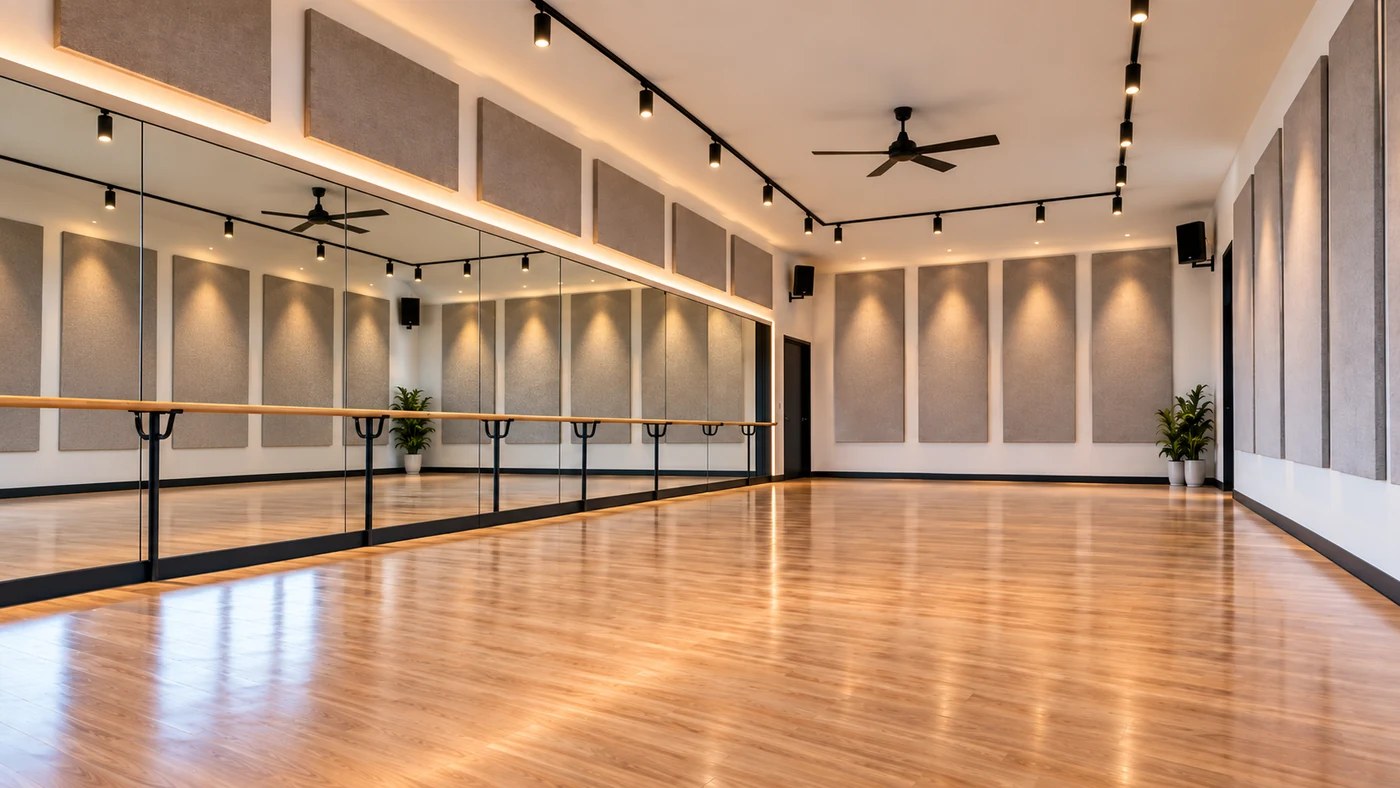
Where Do You Put Acoustic Panels When the Walls Are Covered in Mirrors?
This is one of the biggest practical challenges in a dance studio.
Mirrors may occupy most of one wall—and sometimes several walls.
Covering them with acoustic panels obviously isn't an option.
The solution is to identify the remaining usable surfaces.
Above Mirror Height
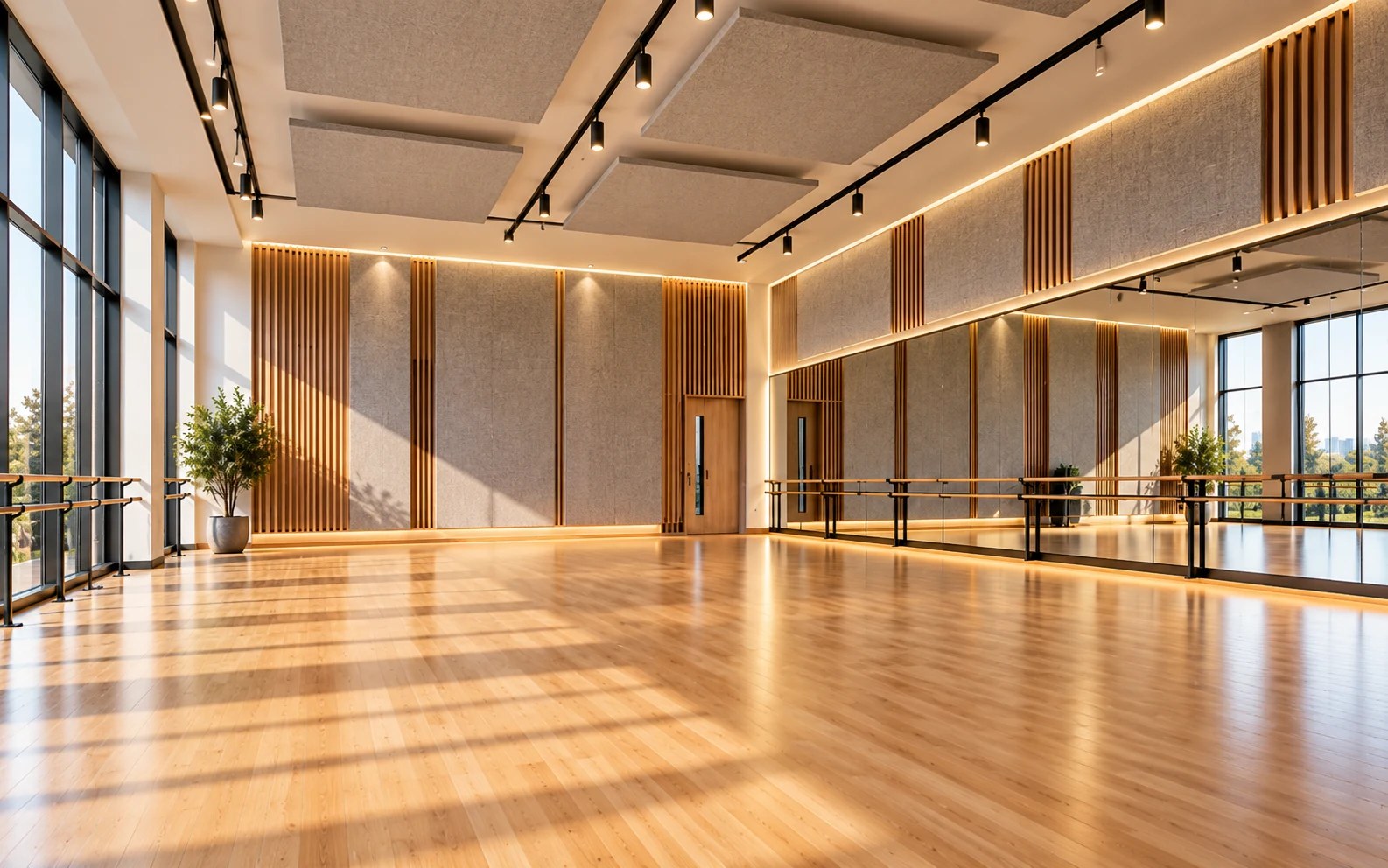
If there is available wall area between the top of the mirrors and the ceiling, it can provide a useful location for acoustic treatment.
This allows panels to contribute absorption without interfering with the visual function of the mirrors or occupying the primary active zone.
Opposite the Mirrors
If a solid wall faces a large mirrored surface, it can be particularly useful for acoustic treatment.
Rather than having two highly reflective surfaces facing one another, adding absorption to the available wall helps reduce repeated reflections across the room.
Side and Rear Walls
Any available solid wall area should also be considered.
Treatment doesn't necessarily need to form one continuous feature wall.
Panels can be distributed across suitable surfaces according to the room layout and required acoustic performance.
Keep Acoustic Treatment Out of Active Zones
Dance and rehearsal spaces need clear movement areas.
People may be moving quickly, stretching, lifting, using equipment or working close to the walls.
Panel placement therefore needs to consider more than acoustics.
In high-contact areas, wall-mounted treatment may be vulnerable to accidental impact or may interfere with the way the room is used.
Installing panels above mirror height or above the primary contact zone can help address this issue.
This is particularly useful where treatment is needed but floor-level walls need to remain clear.
The correct height will depend on the studio layout and activities taking place in the room.
Why the Ceiling Is So Important
When mirrors and active zones limit wall treatment, the ceiling becomes one of the most valuable acoustic surfaces available.
It can provide a substantial treatment area without interfering with:
- Mirrors
- Dance movement
- Equipment
- Wall-mounted barres
- Doors
- Storage
- Floor area
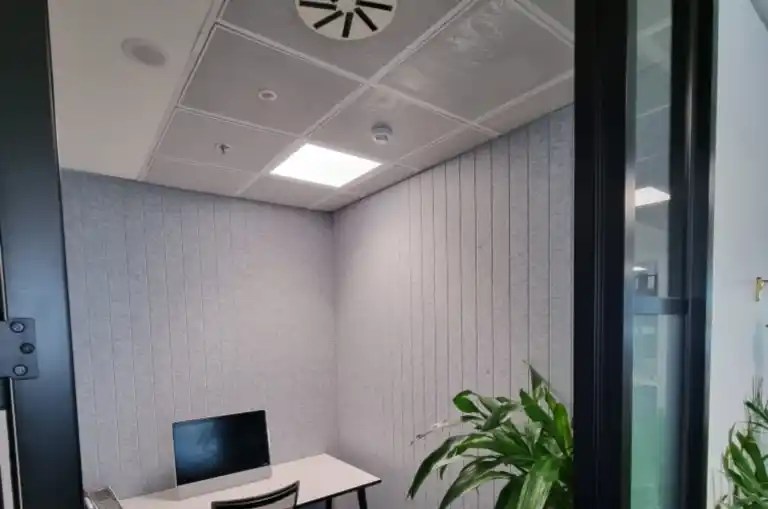
Acoustic ceiling panels can be incorporated where an appropriate ceiling structure is available.
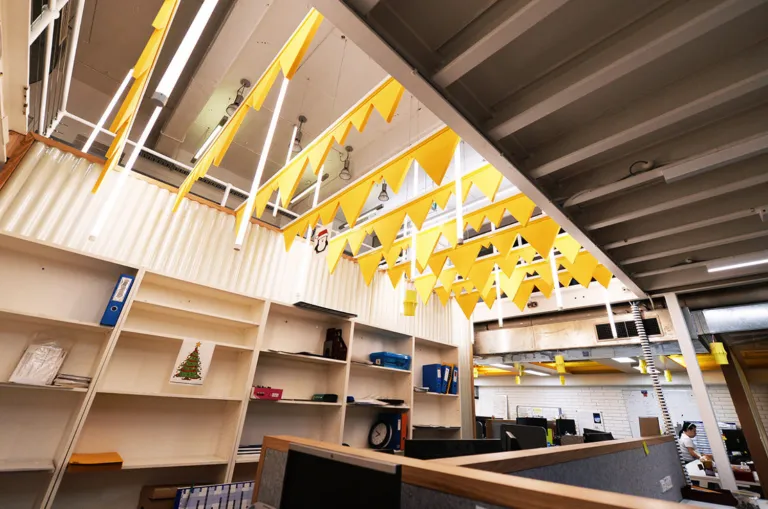
For exposed or high ceilings, suspended acoustic baffles may provide another option.
Baffles can introduce absorption while maintaining an open-ceiling aesthetic and can often be coordinated around lighting and building services.
Using the ceiling also allows treatment to be distributed more evenly across a larger studio rather than concentrating all the absorption on one wall.
Dance Studios and Rehearsal Rooms Aren't Acoustically Identical
Although dance and rehearsal spaces share many characteristics, the acoustic requirements can differ.
Dance Studios
Dance studios typically prioritise:
- Music clarity
- Instructor intelligibility
- Movement
- Mirrors
- Open floor space
Treatment needs to improve acoustic control without interfering with these functions.
Rehearsal Studios
A rehearsal space may contain:
- Amplified music
- Live instruments
- Vocals
- Percussion
- Multiple performers
The acoustic environment may therefore contain a broader range of frequencies and significantly higher sound levels.
A rehearsal room used by amplified bands requires a different acoustic strategy from a studio primarily used for dance instruction.
The treatment should always be selected according to what actually happens in the room.
Handling Lower Frequencies From Amplified Music
One important consideration in rehearsal rooms is low-frequency sound.
Standard thin absorptive treatments tend to be more effective at middle and higher frequencies than at low frequencies.
This matters when the room contains amplified sources such as:
- Bass guitar
- Kick drum
- Electronic music
- Subwoofers
- Amplified instruments
Where stronger low-frequency absorption is required, thicker acoustic treatment and appropriate mounting configurations can provide better performance than relying solely on thin panels.
This is also why NRC shouldn't be the only number considered when selecting an acoustic product.
NRC provides a useful overall indication of absorption, but it doesn't tell the complete story of how a panel performs at individual frequencies.
For music-focused spaces, reviewing octave-band absorption data can provide a better understanding of the product's performance.
Don't Confuse Acoustic Treatment With Soundproofing
This distinction is particularly important for rehearsal studios.
Acoustic panels primarily help control sound reflections inside the room.
They don't automatically prevent amplified music from travelling into neighbouring rooms or buildings.
If music can be clearly heard through adjacent walls, floors, ceilings or doors, the project may have a sound-isolation problem.
That may require consideration of:
- Wall construction
- Ceiling construction
- Floor systems
- Doors and seals
- Glazing
- Service penetrations
- Mechanical systems
- Structural transmission
A studio can therefore have good internal acoustic treatment and still transmit substantial sound to adjacent spaces.
Where sound isolation is critical, specialist acoustic advice may be required in addition to absorptive wall and ceiling treatment.
How Much Acoustic Treatment Does a Studio Need?
There isn't one number of panels that works for every dance or rehearsal studio.
The required amount depends on factors including:
- Room volume
- Ceiling height
- Floor area
- Amount of mirror coverage
- Existing wall and ceiling finishes
- Type of music
- Speaker system
- Number of occupants
- Intended use
- Acoustic performance of the selected panels
A small dance studio used for individual instruction will have different requirements from a large group rehearsal space with amplified music.
The aim should therefore be to establish an appropriate acoustic condition for the room and then determine how much treatment is required to achieve it.
Don't Put All the Panels in One Small Area
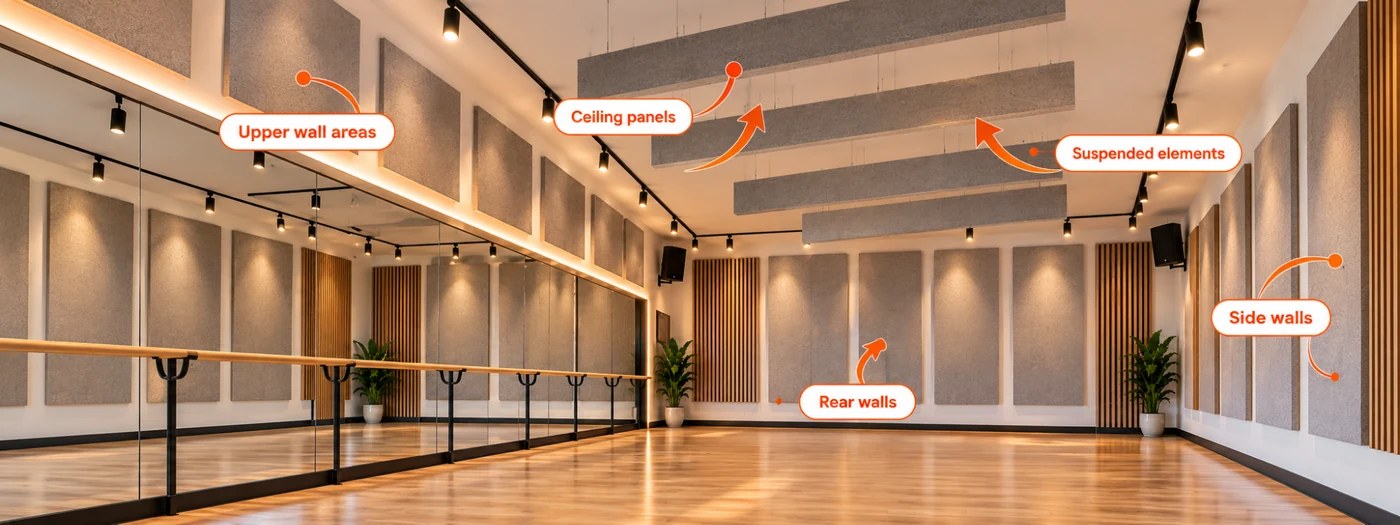
Another consideration is distribution.
If all the available absorption is concentrated in one small section of the room while the remaining surfaces stay highly reflective, the treatment may not provide the most balanced result.
Where practical, absorption can be distributed across:
- Upper wall areas
- Rear walls
- Side walls
- Ceilings
- Suspended ceiling elements
This can help control reflections from different directions.
The exact arrangement should respond to the room geometry and available surfaces rather than following a purely decorative pattern.
Choosing Acoustic Panels for a Dance or Rehearsal Studio
Before selecting a product, consider how the room operates.
Ask:
- Is the studio primarily used for dance, music rehearsal or both?
- How loud is the typical activity?
- Is amplified music used?
- How much of the wall area is covered by mirrors?
- Which wall surfaces remain available?
- Can panels be installed above mirror height?
- Is ceiling treatment practical?
- Are there high-contact areas to avoid?
- Is additional low-frequency absorption required?
- What fire performance applies to the project?
- Is sound transmission to adjacent spaces also a concern?
These questions help determine the type, thickness, quantity and placement of treatment required.
Fire Performance and Project Requirements
Acoustic panels used as internal wall or ceiling linings need to satisfy the applicable fire requirements for the building and project.
The required classification depends on factors such as the building classification, location of the panels, selected material and product configuration.
Project teams should confirm:
- Applicable building classification
- Required fire performance
- Panel location
- Product configuration
- Relevant test documentation
Fire performance should be checked for the actual acoustic panel system being specified rather than assumed from its appearance or material category.
Acoustic Panels Australia can provide relevant technical and fire-performance information to assist architects, builders and specifiers during product selection.
Design Doesn't Need to Be Sacrificed
Dance studios are visual spaces.
Mirrors, lighting, flooring and colour all contribute to the atmosphere of the room.
Acoustic treatment doesn't need to work against that design.
Wall and ceiling panels can be incorporated using:
- Coordinated colours
- Geometric arrangements
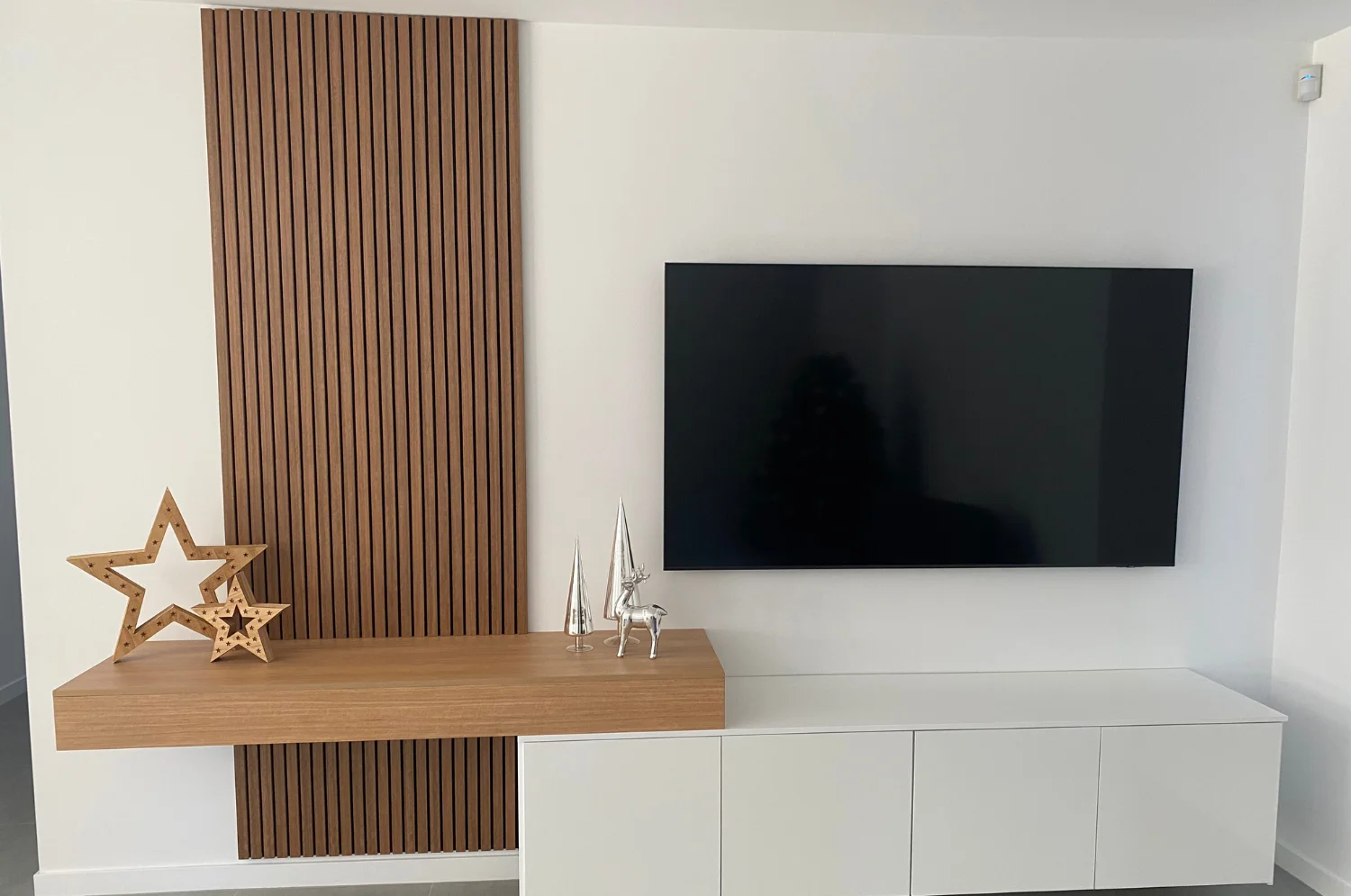
- Linear patterns
- Ceiling features
- Custom configurations
- Architectural finishes
Upper-wall panels can become part of the visual composition above the mirrors, while ceiling treatment can introduce another layer of texture or rhythm.
Instead of looking like a technical correction, the acoustic treatment can become part of the studio's architectural identity.
Why Choose Acoustic Panels Australia?
Acoustic Panels Australia manufactures acoustic solutions for commercial and public spaces across Australia.
For dance and rehearsal studios, our team can help consider the practical constraints that make these rooms different from standard offices or meeting rooms.
That includes:
- Acoustic wall panels
- Acoustic ceiling panels
- Suspended acoustic baffles
- Panel thickness and performance
- Octave-band acoustic data
- Placement around mirrors
- Treatment of upper wall areas
- Colours and finishes
- Fire-performance documentation
- Project-specific specification support
The aim is to create an acoustic treatment that works with the music, movement and architecture of the studio rather than treating them as separate considerations.
Planning Acoustics for a Dance or Rehearsal Studio?
A studio filled with mirrors and hard surfaces doesn't need to remain excessively reverberant.
Strategically placed acoustic panels above mirror height, across available walls and on the ceiling can introduce the absorption needed to improve music clarity and make spoken instruction easier to understand.
For rehearsal spaces using amplified music, panel thickness and frequency-specific performance should also form part of the specification.
Send us your plans, room dimensions, photos and information about how the studio will be used, and our team can help identify an appropriate acoustic treatment.
Contact Acoustic Panels Australia to specify acoustic treatment for your dance or rehearsal studio.