How to Improve Speech Clarity in a Meeting Room
Learn how acoustic wall and ceiling panels reduce reverberation in meeting rooms to improve speech clarity, video calls and everyday conversations.
A meeting room doesn't need to be particularly large to have an acoustic problem.
In fact, some of the most frustrating speech problems happen in relatively small rooms.
Glass walls, plasterboard, hard floors, tables, screens and other reflective surfaces can cause speech to bounce around the space. Instead of words reaching listeners clearly, they arrive together with multiple reflections.
The result can be a room where people can hear that someone is speaking but have to work harder to understand exactly what is being said.
The problem becomes even more noticeable during video calls.
Microphones don't only capture the person speaking. They can also pick up reflected sound from around the room, making voices sound distant, hollow or unclear to people joining remotely.
Improving speech clarity therefore isn't simply about making a meeting room quieter.
It is about controlling reverberation so speech remains clear and intelligible.
Acoustic wall panels, ceiling panels and other absorptive treatments can help achieve this by reducing the reflections that interfere with conversation.
Why Do Meeting Rooms Sound Unclear?
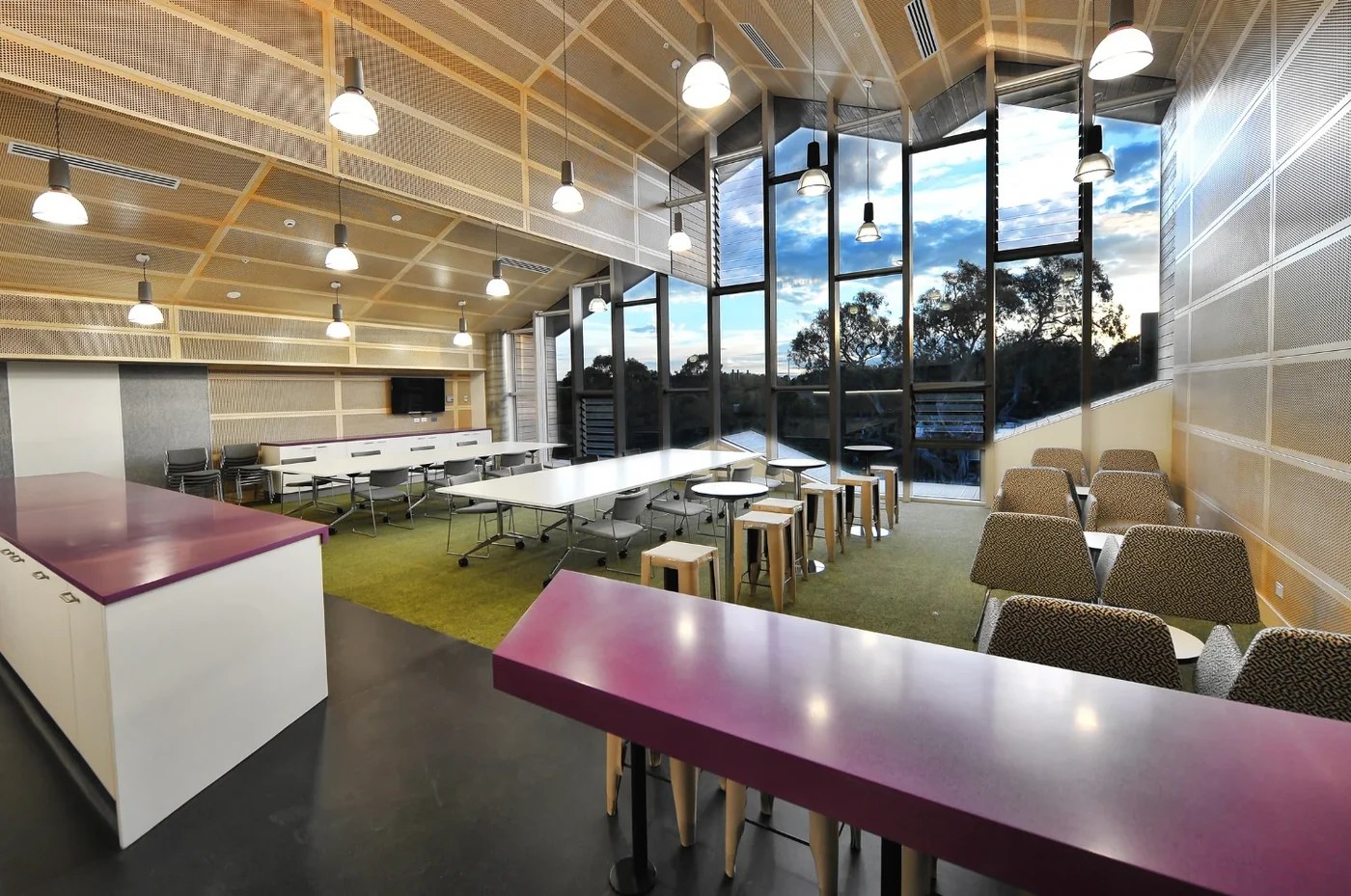
Many modern meeting rooms are visually clean but acoustically reflective.
Consider a typical room containing:
- Glass partitions
- Painted plasterboard walls
- A hard or relatively reflective floor
- A large meeting table
- Display screens
- Whiteboards
- Minimal soft furnishings
Most of those surfaces provide little meaningful sound absorption.
When someone speaks, sound travels directly to the other people in the room. At the same time, it travels towards the walls, ceiling, glazing and other surfaces.
Those surfaces reflect some of the sound back into the room.
If the room has insufficient absorption, those reflections continue after the original sound has been produced.
This persistence of sound is known as reverberation.
A small amount is normal. Too much can reduce speech clarity.
How Reflections Affect Speech
Speech contains a rapid sequence of different sounds.
For those sounds to remain intelligible, listeners need to distinguish them from one another.
In a reverberant meeting room, reflections from one syllable can remain in the space as the next syllable is spoken.
The words begin to overlap acoustically.
This can make it harder to distinguish:
- Similar-sounding words
- Softer consonants
- Fast conversation
- People speaking quietly
- Speakers positioned further away
The effect can become more noticeable when several people are participating in a discussion or when background noise from outside the room is also present.
The objective of acoustic treatment is therefore not to eliminate every reflection.
It is to control excessive reflections so direct speech remains dominant.
Why Video Calls Make Poor Meeting Room Acoustics More Obvious
Hybrid meetings have made meeting room acoustics increasingly important.
A person sitting inside the room may compensate for poor acoustics without consciously noticing it. They can see who is speaking, watch facial expressions and naturally focus on the person across the table.
A remote participant doesn't have all of those advantages.
They hear whatever reaches the room's microphone.
That can include:
- Direct speech
- Reflections from walls
- Ceiling reflections
- Table reflections
- HVAC noise
- Movement within the room
- Other background sounds
When the room is reverberant, the microphone can capture both the speaker and the acoustic tail created by the room.
To the remote listener, this can make voices sound less defined.
Increasing the microphone volume doesn't solve the underlying problem. In some cases, it simply increases the level of both the speech and the unwanted room sound.
Treating the room acoustics at the source can provide a better foundation for the conferencing technology to work effectively.
How Acoustic Panels Improve Speech Clarity
Acoustic panels work by absorbing a portion of the sound energy that reaches them.
Instead of allowing most of the sound to reflect from a hard wall or ceiling back into the meeting room, an absorptive surface reduces those reflections.
As more appropriate absorption is introduced, reverberation can be shortened.
This can help create:
- Clearer in-room conversation
- Better speech intelligibility
- Less noticeable echo
- More controlled room sound
- Improved conditions for microphones
- More comfortable meetings
This is why meeting room acoustic treatment should be considered as part of the room design rather than only after users complain about sound.
Where Should Acoustic Panels Go in a Meeting Room?
A small meeting room usually doesn't require every available surface to be covered.
Strategic placement can make much better use of the available treatment area.
Wall Panels
Walls are often the simplest place to introduce acoustic absorption.
Large uninterrupted plasterboard walls are particularly useful because they would otherwise reflect sound strongly.
Panels can be installed:
- Behind participants
- On side walls
- On the wall opposite glazing
- Behind or around the video conferencing area
- As part of an architectural feature wall
Where a room has extensive glazing on one side, treating an available solid wall can help balance some of that reflectivity.
Ceiling Panels
The ceiling can provide another valuable treatment area.
This is especially useful when wall space is limited by:
- Glass partitions
- Screens
- Whiteboards
- Joinery
- Doors
- Other equipment
Ceiling-mounted acoustic treatment can distribute absorption across the room without occupying usable wall space.
In some meeting rooms, combining wall and ceiling absorption provides a more balanced result than concentrating all treatment in one small area.
How Much Acoustic Panel Coverage Is Enough?
There isn't a single percentage that is correct for every meeting room.
The amount of acoustic treatment required depends on factors including:
- Room dimensions
- Ceiling height
- Existing finishes
- Amount of glazing
- Floor finish
- Furniture
- Number of occupants
- Intended use
- Acoustic performance of the selected panel
A small room with carpet, curtains and other absorptive finishes may require less additional treatment than a similar-sized room surrounded by glass and hard surfaces.
However, acoustic treatment does not necessarily need to cover every wall before it becomes useful.
Even partial wall coverage can noticeably reduce reverberation in a small meeting room when the treatment is appropriately selected and positioned.
The goal should be sufficient absorption for the acoustic conditions of the room—not simply covering an arbitrary percentage of the walls.
Don't Choose Panels Based on NRC Alone
When comparing acoustic panels, it can be tempting to look only at the NRC rating.
NRC, or Noise Reduction Coefficient, provides a useful summary of sound absorption performance, but it should not be the only consideration.
Meeting room acoustics are affected by:
- Panel absorption performance
- Frequency-specific performance
- Total treatment area
- Panel thickness
- Installation method
- Mounting conditions
- Position within the room
A high-performing product installed across too little surface area may not achieve the desired result.
Similarly, selecting a panel because it has the highest number on a specification sheet doesn't automatically mean it is the best solution for the room.
The panel, coverage and placement need to work together.
What About Privacy Between Meeting Rooms?
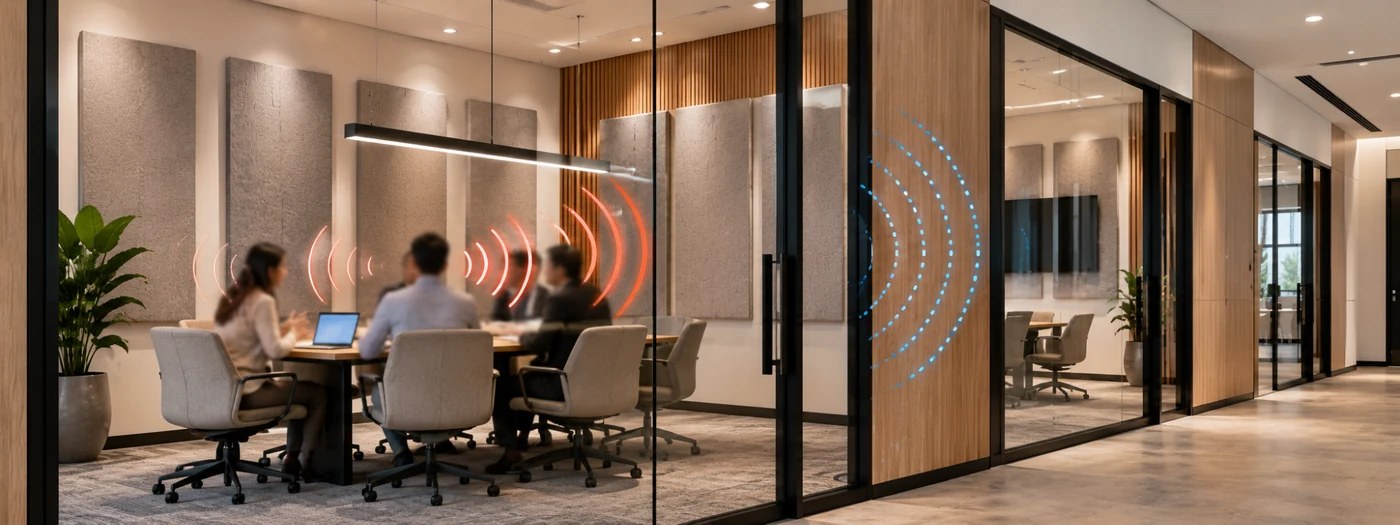
Speech clarity and speech privacy are related acoustic issues, but they are not the same problem.
This distinction is important.
Acoustic panels primarily help control sound reflections within a room.
They are not automatically a solution for sound travelling through walls, doors, ceilings or other building elements into adjacent spaces.
If people outside the meeting room can clearly hear confidential conversations, the issue may involve:
- Wall construction
- Door seals
- Gaps around services
- Ceiling paths
- Glazing
- Mechanical services
- Other sound transmission paths
In those situations, additional sound isolation measures may be required.
A room can therefore have excellent internal speech clarity and still have poor privacy—or vice versa.
Understanding which problem you are trying to solve is the first step towards choosing the right treatment.
Meeting Room Acoustics Should Be Considered Early
Acoustic treatment is much easier to integrate when it is considered during the design stage.
Waiting until the room is complete can limit where panels can be installed.
By that point:
- Glazing positions are fixed
- Screens are installed
- Joinery occupies wall space
- Lighting and services occupy the ceiling
- Interior finishes have already been selected
Acoustic treatment then has to compete for whatever surface area remains.
Considering acoustics earlier allows the architect or designer to incorporate absorption into the room itself.
For example, an acoustic wall treatment can become part of the visual design rather than appearing as a corrective measure added after handover.
Choosing Acoustic Panels for a Meeting Room
Acoustic performance is important, but it isn't the only specification consideration.
The selected product should also work with the architectural and practical requirements of the project.
Consider:
- Required sound absorption
- Available wall and ceiling area
- Panel thickness
- Colour and finish
- Panel dimensions
- Installation method
- Durability
- Maintenance
- Fire performance
- Integration with the interior design
Meeting rooms are often highly visible spaces, particularly in client-facing workplaces.
That means acoustic treatment can also provide an opportunity to introduce colour, texture or architectural detailing rather than simply functioning as a technical addition.
Fire Compliance for Meeting Room Acoustic Panels
Acoustic panels used as internal wall or ceiling linings need to be selected with the building's fire requirements in mind.
The appropriate fire classification depends on factors such as the building classification, location of the panels, selected product and project requirements.
For that reason, fire performance should be confirmed for the specific acoustic panel and configuration being specified.
Don't assume that all acoustic products—or every variation of the same product—have identical fire performance.
Relevant fire testing and technical documentation should form part of the specification process.
Acoustic Panels Australia can assist project teams with the appropriate product information when selecting panels for commercial meeting rooms.
A Better Meeting Room Is About More Than Technology
It is easy to focus on cameras, microphones, speakers and displays when designing a modern meeting room.
Those systems are important, but they operate inside an acoustic environment.
If that environment is highly reverberant, even good conferencing equipment has to work with a poor starting point.
A better approach is to consider the room as a complete system:
Room acoustics + technology + layout + finishes.
Controlling sound reflections provides a better acoustic foundation for both face-to-face and hybrid communication.
The result isn't simply a room that sounds quieter.
It is a room where people can understand one another more easily.

Why Choose Acoustic Panels Australia?
Acoustic Panels Australia manufactures acoustic solutions for commercial projects across Australia.
For meeting rooms, our team can help architects, designers, builders and project teams consider the complete treatment rather than simply selecting a panel from a catalogue.
That includes factors such as:
- Panel selection
- Wall and ceiling applications
- Acoustic performance
- Coverage
- Placement
- Colours and finishes
- Fire performance
- Technical documentation
By considering these elements together, acoustic treatment can become an intentional part of the meeting room design rather than a problem that needs to be corrected after the space is occupied.
Need Better Speech Clarity in Your Meeting Rooms?
If conversations sound unclear, video calls feel hollow or the room has noticeable reverberation, the issue may not be the microphone—it may be the room itself.
Adding appropriately selected acoustic treatment to available wall and ceiling areas can reduce reflections and create a more controlled environment for communication.
Send us your room dimensions, plans, photos or project requirements, and our team can help determine an appropriate acoustic panel solution.
Contact Acoustic Panels Australia to specify your meeting room acoustic treatment.