Acoustic Panels for a Police or Emergency Services Facility
Learn how acoustic panels improve speech clarity and control reverberation in police stations, interview rooms, control rooms and emergency services facilities.
Police stations and emergency services facilities contain some of the most communication-intensive spaces in a public building.
Interview rooms need clear conversation. Control rooms may have multiple radios, phones and operators working simultaneously. Public counters need staff and visitors to understand each other without every conversation becoming part of the surrounding noise.
These spaces also tend to use hard, durable materials.
Glass, plasterboard, masonry, hard flooring, joinery and other robust finishes make sense from an operational and maintenance perspective, but they can also reflect sound.
When there isn't enough absorption in the room, those reflections increase reverberation and make communication more difficult.
Appropriately selected acoustic wall and ceiling panels can help control reflected sound, improve speech intelligibility and create more suitable acoustic conditions for these demanding environments.
However, acoustics in police and emergency services facilities need to be considered carefully. Sound absorption and speech privacy are not the same thing, and sensitive rooms may require both internal acoustic treatment and separate sound-isolation measures.
Where Do Clarity and Privacy Matter Most?
Not every area of a police or emergency services facility has the same acoustic priorities.
A corridor, interview room and emergency control centre perform completely different functions.
The first step should therefore be identifying the spaces where communication is most critical.
Priority areas may include:
- Interview rooms
- Control rooms
- Communications rooms
- Public counters
- Reception and waiting areas
- Meeting rooms
- Briefing rooms
- Offices
- Consultation spaces
- Staff areas
In some rooms, the primary objective is speech clarity.
In others, confidentiality and speech privacy may be just as important.
Often, both need to be considered together.
Why Hard Surfaces Can Make Communication Difficult
Public and operational facilities need materials that can withstand regular use.
That often leads to interiors containing large areas of:
- Hard flooring
- Glass
- Painted plasterboard
- Masonry
- Timber or laminate joinery
- Metal
- Solid doors
- Other durable finishes
These surfaces generally provide limited sound absorption.
When someone speaks, their voice reaches the listener directly, but it also travels towards the surrounding walls, floor and ceiling.
Those surfaces reflect part of the sound back into the room.
When there are too many reflections, speech can become less distinct.
In a quiet office this may be frustrating.
In a room where interviews, radio communication or operational instructions are taking place, speech clarity can be significantly more important.
Interview Room Acoustics
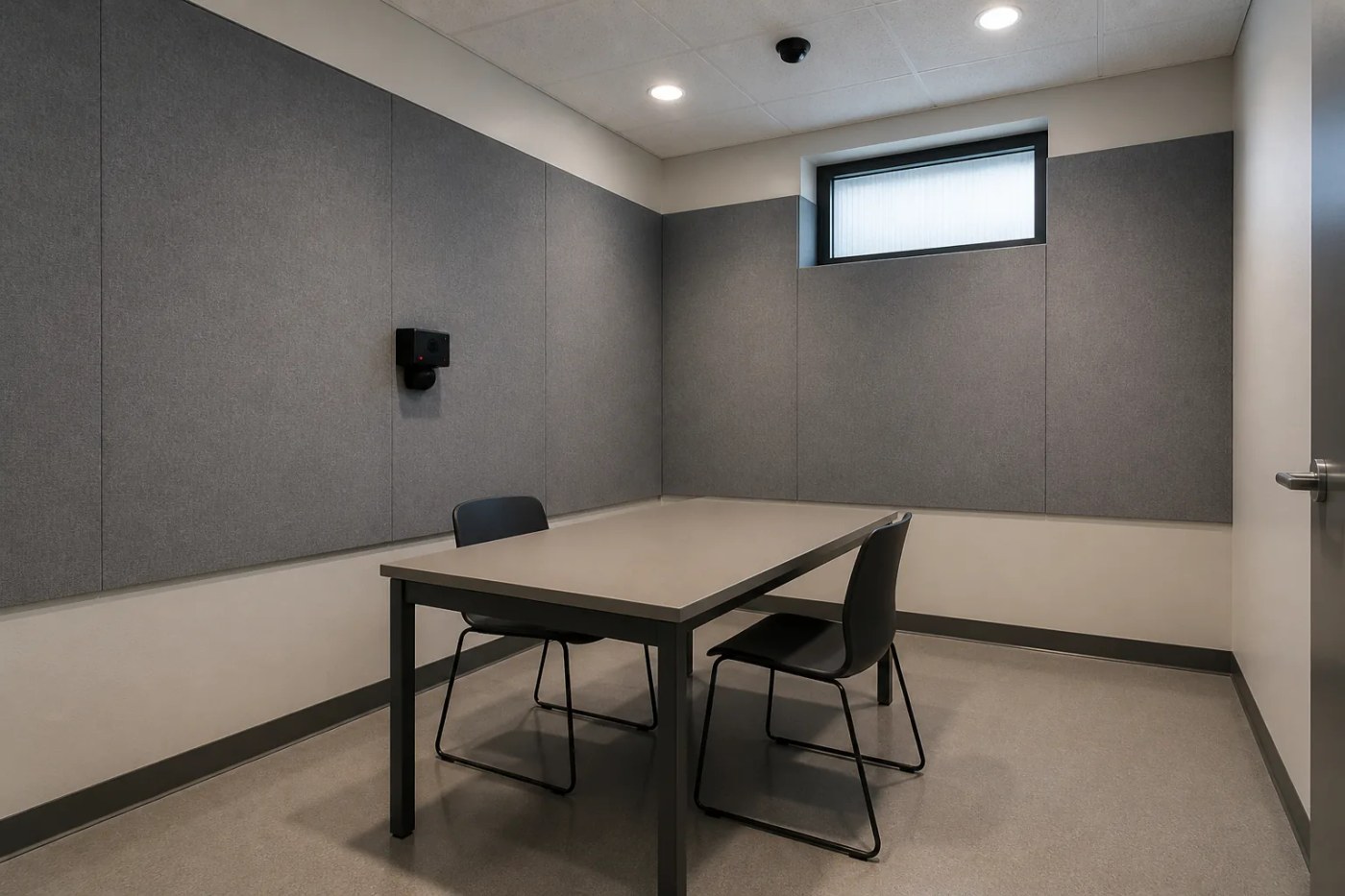
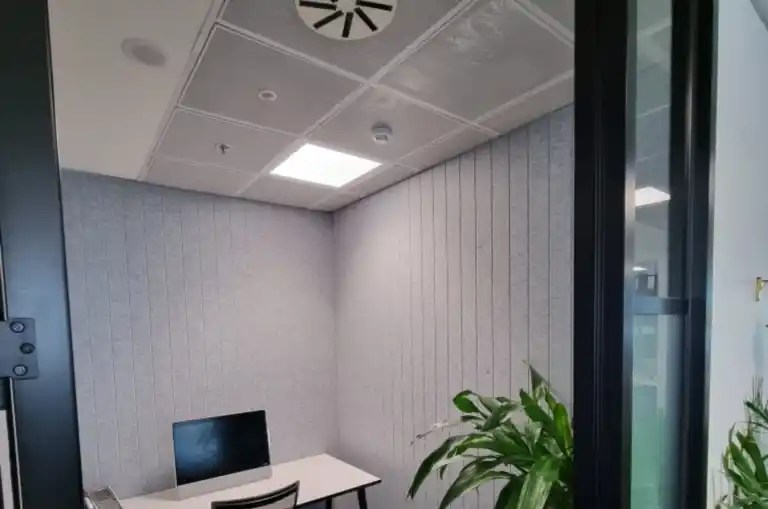
An interview room is a good example of a small space where acoustic performance can easily be overlooked.
The room may contain only a table, chairs, recording equipment and a limited number of furnishings.
If the walls, ceiling and floor are predominantly reflective, speech can sound noticeably reverberant despite the relatively small room size.
Acoustic wall or ceiling treatment can help absorb those reflections and create a more controlled environment for conversation.
This can support:
- Clearer face-to-face speech
- More comfortable communication
- Better conditions for recording equipment
- Reduced reverberation
- Improved speech intelligibility
The treatment should also be appropriate for the operational requirements of the room, including durability, maintenance and applicable building requirements.
Speech Privacy Requires More Than Acoustic Panels
This distinction is particularly important in police and emergency services environments.
Acoustic absorption does not automatically provide soundproofing.
Wall and ceiling panels primarily reduce reflections inside a room.
If the concern is that a sensitive interview can be clearly heard in the adjoining corridor or neighbouring room, the issue involves sound transmission.
Speech may travel through:
- Wall constructions
- Doors
- Gaps around doors
- Glazing
- Ceiling voids
- Service penetrations
- Junctions between building elements
- Mechanical systems
In these situations, improving internal absorption may form one part of the acoustic strategy, but additional sound-isolation measures may also be required.
For spaces involving confidential or sensitive communication, the wall, door, ceiling and service constructions should therefore be considered alongside internal acoustic treatment.
Control Rooms and Communication Centres
Control rooms present a different challenge.
Instead of one conversation taking place at a time, there may be multiple simultaneous sound sources.
These can include:
- Radio communications
- Telephones
- Staff conversations
- Alert tones
- Computer equipment
- Mechanical services
- Other operational systems
If the room is highly reflective, sound from each source can contribute to the overall acoustic environment.
This can make individual messages more difficult to distinguish, particularly during periods of high activity.
Introducing appropriate sound absorption can reduce the build-up of reflected sound and create better conditions for communication.
Treatment may be incorporated through wall panels, ceiling systems or other absorptive surfaces depending on the room layout.
Why Control Room Acoustics Should Be Considered Early
Control rooms often contain substantial equipment and infrastructure.
Walls may be occupied by displays. Ceilings may contain lighting, mechanical systems and other services. Workstations can occupy most of the floor area.
If acoustic treatment is considered only after the room has been designed, there may be relatively little suitable surface area remaining.
Planning acoustics earlier allows the project team to coordinate absorption with:
- Screens
- Workstations
- Lighting
- Mechanical services
- Communications equipment
- Ceiling systems
- Wall finishes
This can produce a much more integrated result than trying to add acoustic panels wherever space happens to remain.
Public Counter and Reception Acoustics
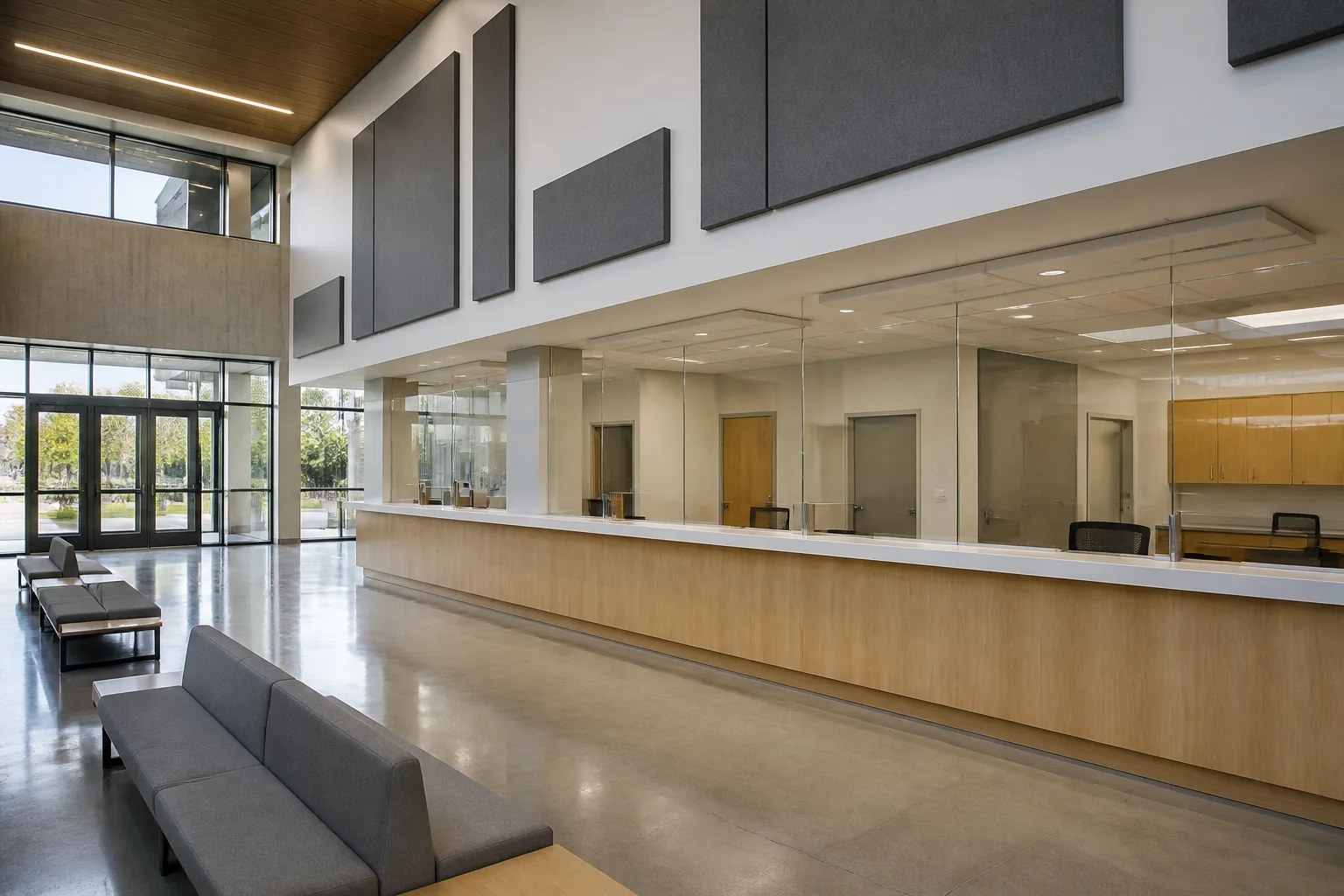
Public-facing areas create another acoustic challenge.
A reception or service counter may have several conversations occurring at the same time.
At the same time, the space may contain:
- Hard flooring
- Glass screens
- Solid counters
- High ceilings
- Large waiting areas
- Reflective walls
Sound from individual conversations can reflect into the surrounding space, increasing the overall noise level and making communication at the counter more difficult.
Adding absorption to available wall and ceiling areas can help reduce reverberation and create a more controlled environment.
This can improve speech clarity between staff and visitors while reducing the general build-up of reflected sound.
Can Acoustic Panels Improve Privacy at a Public Counter?
Acoustic absorption can help reduce reflected sound, but it shouldn't be presented as a complete privacy solution.
If sensitive conversations are taking place at a public counter, other factors may also need to be considered, including:
- Distance between service positions
- Physical layout
- Screening
- Background sound
- Sound transmission paths
- Location of waiting areas
- Overall acoustic design
Acoustic panels can contribute by reducing the amount of reflected sound circulating around the space.
However, where specific speech-privacy requirements apply, the complete acoustic environment should be assessed rather than relying on wall panels alone.
Wall or Ceiling Panels: Which Should Be Used?
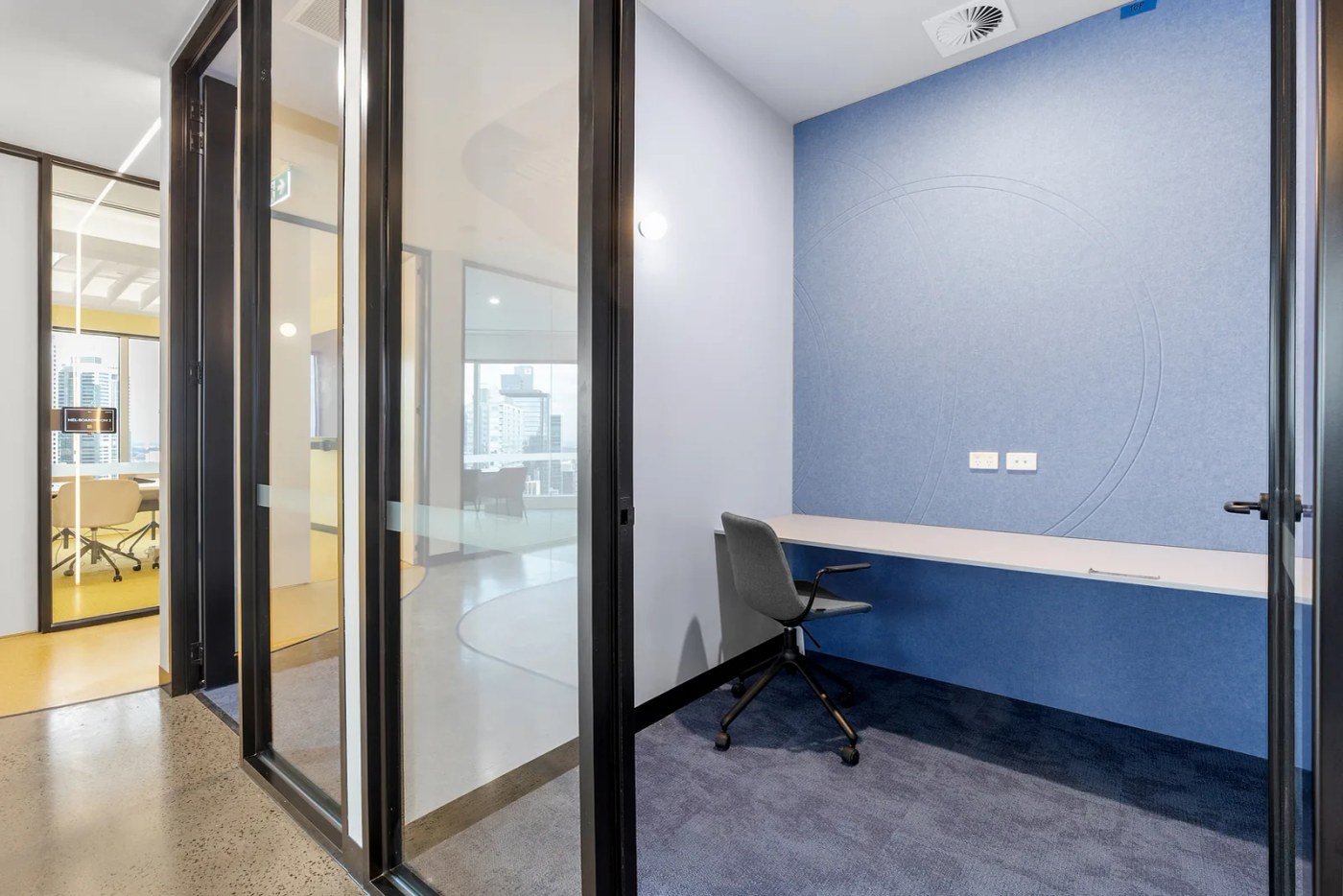
The best location depends on the individual room.
Acoustic Wall Panels
Wall treatment can work well in:
- Interview rooms
- Meeting rooms
- Offices
- Briefing spaces
- Reception areas
Panels can be positioned on large reflective surfaces while also contributing colour or texture to the interior.
Acoustic Ceiling Panels
Ceiling treatment can be useful where wall space is occupied by:
- Glazing
- Screens
- Equipment
- Joinery
- Doors
- Other operational requirements
Ceiling absorption can also distribute treatment across a larger area without taking up usable wall space.
Combining Wall and Ceiling Treatment
Some spaces benefit from using both.
Rather than assuming one treatment type is always preferable, the design should consider the available surface area, room geometry and required acoustic outcome.
Durable Acoustic Panels for Demanding Environments
Police and emergency services buildings are high-use environments.
Acoustic treatment therefore needs to be selected for more than sound absorption alone.
Depending on where it is installed, the panel may need to withstand:
- Frequent use
- Accidental contact
- Cleaning
- General wear
- High occupancy
- Operational activity
Placement matters as well.
In areas where wall contact is likely, more durable finishes may be required or panels may be positioned above the highest-contact zone.
The correct solution should balance acoustic performance, durability and maintainability.
Fire Performance and Compliance
Acoustic panels installed as wall or ceiling linings also need to satisfy the applicable fire-performance requirements for the building.
Police and emergency services facilities can contain different building classifications and uses, so the required classification should be established for the specific project and area rather than assumed from the facility name alone.
Project teams should confirm:
- Applicable NCC building classification
- Required fire performance
- Panel location
- Selected material and finish
- Tested product configuration
- Supporting fire documentation
Where a Group 1 fire classification is required, the selected acoustic panel system should have appropriate evidence supporting that performance for the configuration being specified.
Acoustic Panels Australia can provide relevant fire-performance and technical documentation to assist with product specification.
Acoustic Performance Should Match the Room
Not every room needs the same panel thickness, treatment area or acoustic performance.
A small interview room and a large control room may both require acoustic treatment, but the conditions are very different.
Factors influencing the amount of treatment include:
- Room dimensions
- Ceiling height
- Existing finishes
- Amount of glazing
- Occupancy
- Equipment
- Intended use
- Required speech conditions
- Acoustic performance of the selected panel
- Available treatment area
For complex operational areas or spaces with specific privacy requirements, an acoustic consultant may be needed to establish appropriate criteria and assess the complete room construction.
Treat Priority Rooms First
When an existing facility has multiple acoustic issues but treatment needs to be staged, prioritisation can help.
Start with rooms where poor acoustics have the greatest impact on communication and operation.
A practical priority may be:
1. Interview and sensitive consultation roomsClear communication and appropriate privacy are particularly important.
2. Control and communications roomsMultiple simultaneous sound sources make reverberation control valuable.
3. Public counters and reception areasBetter absorption can improve communication and reduce reflected sound across busy public-facing spaces.
4. Briefing and meeting roomsSpeech clarity is important for group communication.
5. Other offices and shared areasTreatment can then be expanded according to the acoustic conditions and available budget.
The final priorities should, of course, reflect how the individual facility operates.
Choosing the Right Acoustic Solution
Before selecting acoustic panels for a police or emergency services facility, consider:
- What happens in the room?
- How important is speech intelligibility?
- Is confidentiality required?
- Is the problem reverberation, sound transmission or both?
- How durable does the finish need to be?
- Which wall and ceiling areas are available?
- What acoustic performance is required?
- What fire performance applies?
- Are there specific maintenance requirements?
- Does the room require specialist acoustic design?
These questions help separate a genuine acoustic specification from simply adding panels to an empty wall.
Why Choose Acoustic Panels Australia?

Acoustic Panels Australia manufactures acoustic solutions for commercial and public-sector projects across Australia.
For police and emergency services facilities, the appropriate solution needs to respond to more than the appearance of the room.
Our team can assist architects, builders, designers and specifiers with:
- Acoustic wall panels
- Acoustic ceiling treatments
- Product and finish selection
- Acoustic performance information
- Treatment placement and coverage
- Durable panel options
- Fire-performance documentation
- Samples and technical information
- Project-specific specification support
Where privacy or sound isolation is also required, we can help distinguish the role of absorptive panels from the broader building-acoustic requirements so the correct issues can be addressed.
Planning Acoustics for a Police or Emergency Services Facility?
Interview rooms, control rooms and public-facing areas all depend on clear communication, but each presents a different acoustic challenge.
The right treatment starts by identifying whether the priority is speech clarity, reverberation control, privacy—or a combination of all three.
Send us your plans, room dimensions and project requirements, and our team can help identify suitable wall and ceiling acoustic treatments for the facility.
Contact Acoustic Panels Australia to specify acoustic treatment for your project.