Acoustic Panels for a Fitness or Spin Studio
Learn how acoustic panels reduce reverberation in fitness and spin studios, improving music clarity, instructor intelligibility and acoustic comfort.
A fitness or spin studio is supposed to feel energetic.
Music is loud, instructors are motivating the class, and dozens of people may be moving at the same time. But when that energy is combined with hard floors, mirrors, glass and bare walls, the room can quickly become louder than it needs to be.
The problem isn't necessarily the music itself.
It is often what happens to that music after it leaves the speakers.
Sound reflects from the floor, ceiling, mirrors and walls, adding to the direct sound from the speakers. Instructor voices, equipment noise and class activity add even more energy.
Instead of sounding powerful and controlled, the music can become a roar. Instructions become harder to distinguish, and simply turning the microphone or speakers up can make the problem worse.
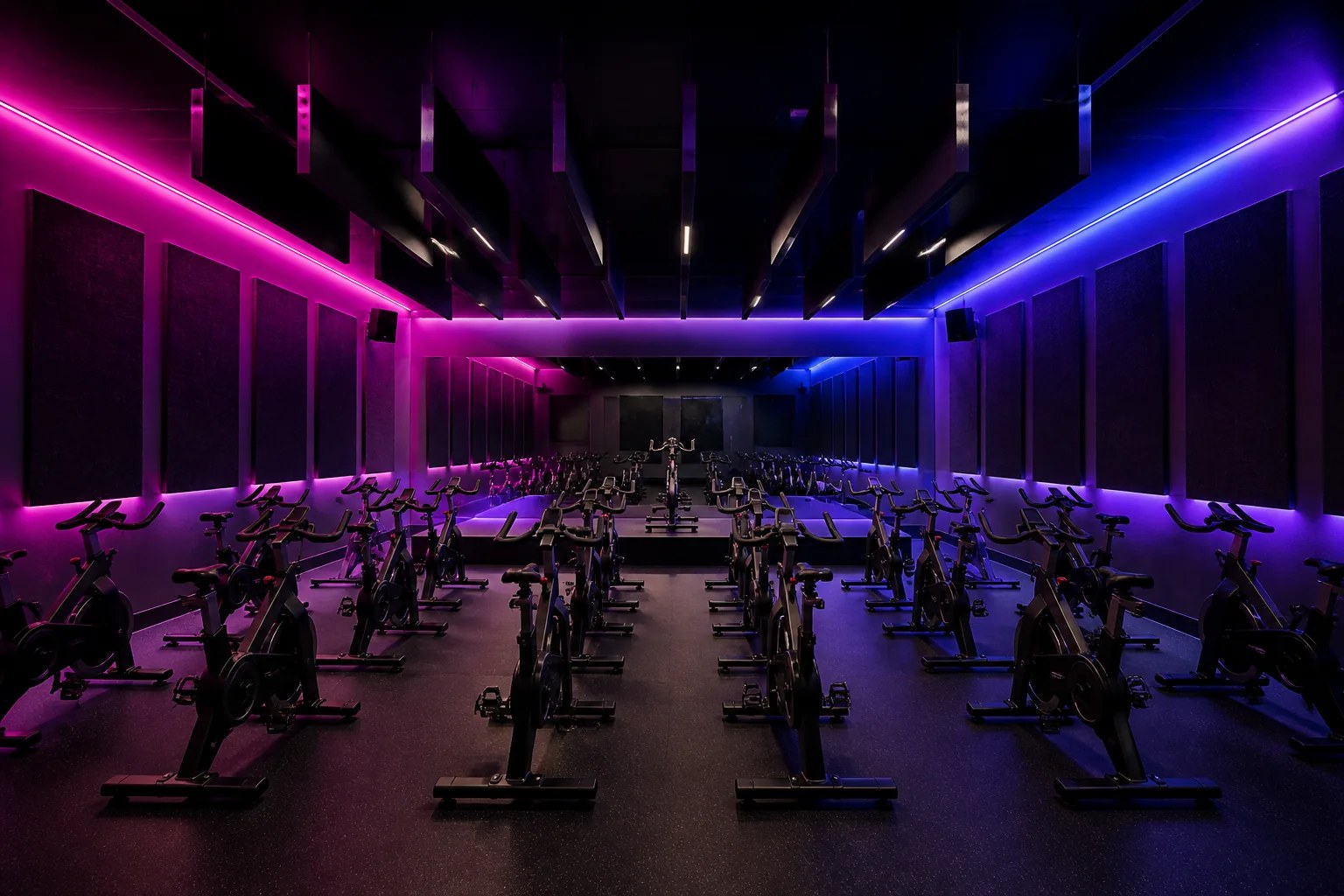
Acoustic wall and ceiling panels help by absorbing some of those reflections. The goal isn't to make a fitness studio quiet. It is to create a room where music stays punchy, instructors remain clear and unnecessary reverberation is controlled.
Why Do Fitness Studios Get So Loud?
Fitness spaces bring together several conditions that can make reverberation particularly noticeable.
A typical studio may contain:
- Hard or resilient flooring
- Large mirrors
- Glass
- Painted plasterboard
- Exposed concrete
- High ceilings
- Minimal soft furnishings
- Powerful loudspeakers
- Multiple occupants
Very little of this provides meaningful sound absorption.
When amplified music enters the room, sound reaches listeners directly from the speakers while also travelling towards the surrounding surfaces.
Those surfaces reflect sound back into the studio.
With music, speech, movement and equipment all producing sound at the same time, the reflections can overlap and contribute to a dense acoustic environment.
The instinct may be to reduce the speaker volume, but that doesn't address the underlying problem: the room itself is retaining too much sound energy.
Music Should Be Punchy, Not Overwhelming
Music is part of the experience in many fitness environments.
A spin class, HIIT session or group workout often relies on music to establish pace and energy.
Good acoustic treatment shouldn't remove that energy.
Instead, it should help the room reproduce the music more cleanly.
When excessive reverberation is reduced, individual sounds have less reflected energy competing with what comes directly from the loudspeakers.
The result can be a more controlled listening environment where music feels powerful without relying solely on higher playback levels.
This distinction is important.
The goal isn't:
"Make the studio quieter."
It is:
"Control the room so the sound system can work effectively."
Hearing the Instructor Over the Music
An instructor has to compete with more than the backing track.
During a typical class, the acoustic environment may include:
- Amplified music
- Instructor microphone
- Participants
- Exercise equipment
- Footfall
- Bikes or machines
- Ventilation systems
If the room is highly reverberant, the instructor's voice reflects from the same surfaces as the music.
Those overlapping reflections can reduce speech intelligibility.
Turning up the microphone can increase the overall sound level without necessarily making individual words clearer.
Reducing reverberation can give the instructor's direct voice a better chance of being understood.
This is especially important when instructions involve changes in movement, equipment use or other information that participants need to hear clearly.
Where Should Acoustic Panels Go?
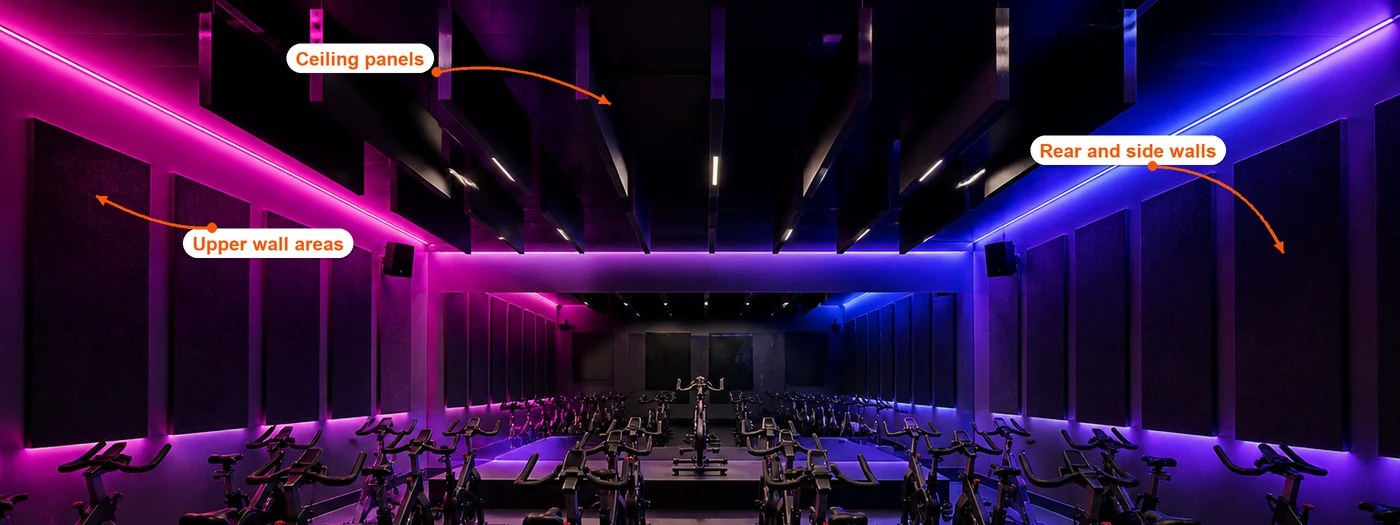
Fitness studios present a practical challenge because large parts of the walls may already be occupied.
Mirrors, equipment, screens, storage and doors can leave relatively little uninterrupted wall area.
The solution is to use the available surfaces strategically.
Upper Wall Areas
Wall space above mirrors or equipment can provide valuable treatment area without interfering with the active zone.
This can be particularly useful where lower walls need to remain accessible or resistant to frequent contact.
Rear and Side Walls
Large solid walls can provide substantial areas for absorption.
Instead of adding a handful of small decorative panels, using meaningful coverage across suitable wall surfaces can have a greater effect on the overall room.
Ceilings
The ceiling can be one of the most useful treatment areas in a fitness studio.
Acoustic ceiling panels or suspended baffles can provide absorption without taking away mirror space or interfering with equipment.
For the strongest overall result, wall and ceiling treatment can be considered together rather than relying on one small area of the room.
Acoustic Treatment Around Mirrors
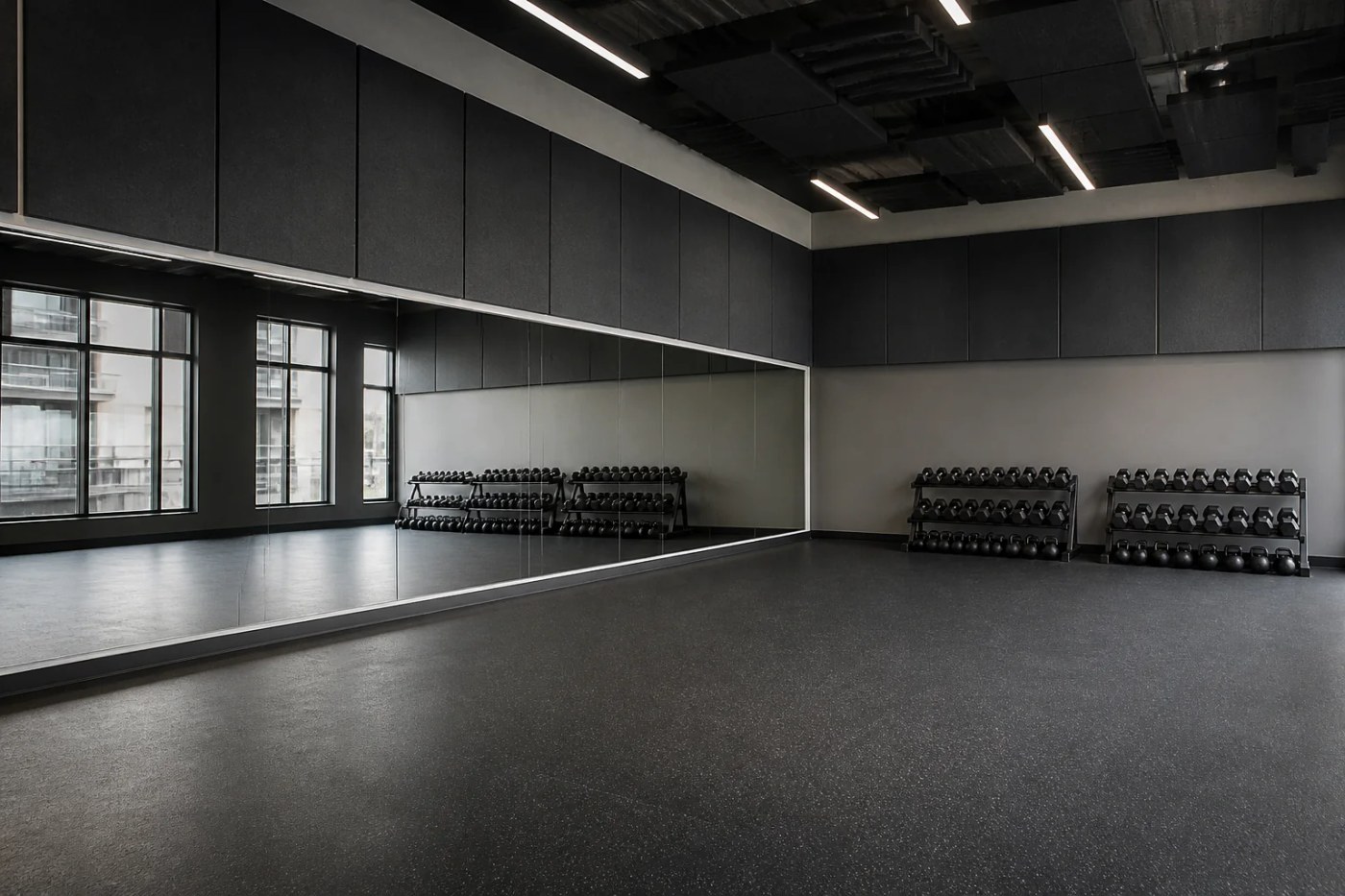
Mirrors are essential in many fitness studios, but acoustically they behave as hard reflective surfaces.
Covering them isn't practical, so the acoustic strategy needs to work around them.
Potential treatment locations include:
- Above the mirrors
- On walls opposite mirrored surfaces
- On adjacent solid walls
- Across available ceiling areas
This allows the mirrors to remain part of the studio while absorption is introduced elsewhere.
If a room has full-height mirrors on several walls, the ceiling becomes even more important because it may represent the largest uninterrupted surface available for treatment.
Why Ceiling Treatment Can Make a Big Difference
A ceiling usually provides a large surface area, making it a valuable location for introducing absorption.
In studios with conventional ceilings, acoustic ceiling panels may be integrated into the design.
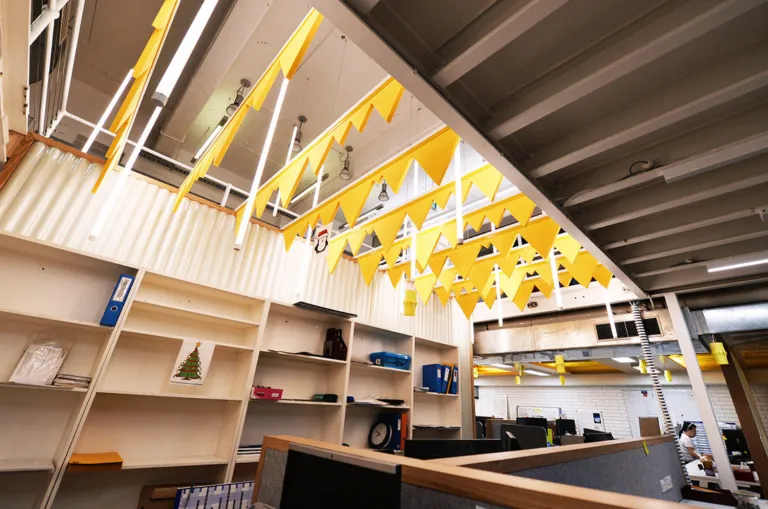
Where the fit-out uses an exposed ceiling, suspended acoustic baffles can provide another approach.
Baffles may be coordinated around:
- Lighting
- Sprinklers
- Mechanical services
- Speakers
- Structural elements
- Other ceiling infrastructure
Because they are suspended within the room, multiple surfaces of a baffle can be exposed to sound.
This can make ceiling treatment particularly useful where the walls are already dominated by mirrors and equipment.
Handling Low-Frequency Workout Music
Fitness and spin music often contains substantial low-frequency energy.
Kick drums, bass lines, electronic music and subwoofers can make low frequencies particularly noticeable.
This creates an important consideration when selecting acoustic panels.
Thin absorptive materials tend to perform better at middle and higher frequencies than they do at lower frequencies.
Where improved lower-frequency absorption is required, thicker acoustic panels and appropriate mounting configurations can provide better performance.
This is one reason a panel shouldn't be selected solely because it has a high headline NRC.
Look Beyond the NRC
NRC, or Noise Reduction Coefficient, provides a convenient overall indication of sound absorption.
But fitness studios are a good example of why the headline number doesn't tell the complete story.
Two acoustic products with similar NRC ratings can perform differently across individual frequencies.
For a room containing amplified music, it can therefore be useful to review frequency-specific or octave-band absorption data.
Panel performance can also be influenced by:
- Thickness
- Density
- Mounting method
- Air gap
- Backing
- Installation configuration
If low-frequency control is an important part of the brief, those details matter.
For more demanding spaces, an acoustic consultant can help establish the required performance across the relevant frequency range.
Acoustic Panels Are Not Soundproofing
If a spin studio is disturbing the tenancy next door, acoustic wall panels may not be the complete solution.
Sound absorption and sound isolation solve different problems.
Acoustic panels primarily reduce reflections within the studio.
If bass, music or equipment noise is travelling through walls, floors or ceilings into neighbouring areas, the project also has a sound-transmission issue.
Possible transmission paths include:
- Walls
- Doors
- Glazing
- Floors
- Ceilings
- Service penetrations
- Mechanical systems
- Structural connections
Low-frequency music can be particularly challenging because bass energy may transmit through building elements and structure.
Where noise transfer to neighbouring spaces is a concern, specialist acoustic assessment may be required.
Durable Panels for High-Use Fitness Environments
Acoustic performance isn't the only consideration in a fitness studio.
These are active commercial spaces that may operate for long hours every day.
Depending on the room and panel location, acoustic finishes may be exposed to:
- Frequent contact
- Perspiration
- Dust
- Cleaning
- Equipment movement
- Accidental impacts
- High occupancy
Product selection should therefore consider durability and maintenance as well as sound absorption.
Where frequent contact is expected, panels may be better positioned above the active zone or a more robust finish may be appropriate.
Where surfaces require regular cleaning, the cleaning and maintenance requirements of the selected product should be reviewed before specification.
Rather than assuming every acoustic product is "wipeable," confirm the manufacturer's maintenance guidance for the exact finish being proposed.
How Much Acoustic Treatment Does a Fitness Studio Need?
There isn't a standard number of panels that works for every fitness or spin studio.
The amount of treatment required depends on:
- Room dimensions
- Ceiling height
- Room volume
- Amount of glazing and mirrors
- Existing finishes
- Speaker system
- Typical music levels
- Number of participants
- Panel performance
- Mounting configuration
- Intended acoustic conditions
A small yoga or movement studio has very different requirements from an enclosed spin room with powerful amplification.
Even two spin studios of the same floor area may need different treatment if one has an absorptive ceiling and the other has exposed concrete.
This is why treatment should be based on the complete room, not simply the number of panels available.
Spread the Treatment Around the Room
Where possible, don't concentrate all the absorption into one small decorative feature.
Fitness studios generate sound throughout the space, and reflections can arrive from many directions.
Depending on the room, useful treatment may be distributed across:
- Upper walls
- Rear walls
- Side walls
- Ceiling areas
- Suspended ceiling elements
This can provide more balanced control of the acoustic environment.
The exact layout should respond to the studio's geometry, available surfaces and acoustic requirements.
Fire Performance for Commercial Fitness Facilities
Acoustic wall and ceiling panels also need to meet the applicable fire-performance requirements for the project.
The requirements depend on factors such as the building classification, location of the treatment, product configuration and relevant National Construction Code provisions.
Before specifying an acoustic panel, project teams should confirm:
- Applicable building classification
- Required fire performance
- Panel location
- Material and substrate
- Finish
- Tested configuration
- Relevant fire-performance documentation
Where a particular Group classification is required, supporting evidence should relate to the product configuration actually being specified.
The project's building surveyor or certifier should confirm the requirements for the specific fit-out.
Acoustic Panels Australia can provide relevant technical and fire-performance information for its systems to support specification.
Choosing the Right Acoustic Panel for a Fitness or Spin Studio
Before selecting the product, consider how the studio actually operates.
Ask:
- What type of classes take place in the room?
- How loud is the music?
- Are subwoofers used?
- Does the instructor use a microphone?
- How much of the room is mirrored?
- Which walls are available for treatment?
- Can panels be installed above mirror height?
- Can the ceiling be treated?
- Is stronger low-frequency absorption needed?
- How durable does the finish need to be?
- What maintenance and cleaning requirements apply?
- Is noise travelling into neighbouring spaces?
- What fire performance is required?
These questions help establish whether the studio needs standard absorptive treatment, thicker panels, ceiling treatment or more specialist acoustic input.
Why Choose Acoustic Panels Australia?

Acoustic Panels Australia manufactures acoustic solutions for commercial interiors across Australia.
For fitness and spin studios, the acoustic strategy needs to work around the practical realities of the space—mirrors, speakers, equipment, high occupancy and frequent use.
Our team can assist architects, designers, builders and specifiers with:
- Acoustic wall panels
- Acoustic ceiling panels
- Suspended acoustic baffles
- Panel thickness and performance options
- Frequency-specific acoustic data
- Treatment placement and coverage
- Durable finish options
- Colours and architectural finishes
- Fire-performance documentation
- Project-specific specification support
The objective is not to take the energy out of the studio.
It is to control unnecessary reflected sound so music, instruction and movement can coexist more comfortably.
Planning Acoustics for a Fitness or Spin Studio?
A fitness studio should feel energetic without becoming acoustically overwhelming.
Strategically placed acoustic panels across the walls and ceiling can reduce excessive reverberation, improve instructor clarity and help amplified music remain powerful without turning into a wall of reflected noise.
Where bass-heavy workout music is used, thicker panels and frequency-specific performance should also be considered.
Send us your plans, room dimensions, photos and information about the sound system and intended use, and our team can help identify an appropriate treatment strategy.
Contact Acoustic Panels Australia to specify acoustic treatment for your fitness or spin studio.