Acoustic Panels for a Concert Hall
Learn how acoustic panels can control unwanted reflections in concert halls while preserving the reverberation, clarity and liveness needed for music.
A concert hall presents a very different acoustic challenge from an office, classroom or restaurant.
In many commercial spaces, reducing reverberation is generally desirable. In a concert hall, however, reverberation is part of the experience.
Music needs enough reflected energy to create richness, warmth and a sense of space. Remove too much of it and the room can sound dry and lifeless. Allow the wrong reflections to dominate and individual notes can blur together, detail can be lost, and different seats may experience very different sound.
That is why the acoustic treatment of a concert hall should never be approached as simply:
"How many acoustic panels can we install?"
The more important question is:
"Which reflections need to be controlled, and which should be preserved?"
Acoustic panels can form an important part of that strategy, but their type, location and quantity need to be carefully considered as part of the overall acoustic design.
For concert halls and other critical music spaces, this is specialist work that should be developed with an experienced acoustic engineer or consultant.
The Acoustic Balance a Concert Hall Needs
A successful concert hall needs to achieve several acoustic objectives at the same time.
Depending on the type of performance and the design of the venue, these can include:
- Musical clarity
- Appropriate reverberation
- Warmth
- Even sound distribution
- Performer-to-performer communication
- Audience engagement
- Controlled early reflections
- Appropriate low-frequency response
- Speech intelligibility when required
These objectives don't always point towards maximum sound absorption.
In fact, covering every available wall and ceiling surface with highly absorptive panels could significantly damage the musical character of the room.
Instead, concert hall acoustics rely on a carefully planned combination of absorption, reflection and diffusion.
Acoustic panels are one part of that system.
Liveness Versus Problem Reflections
"Liveness" describes the sense that sound continues within a room after it has been produced.
In a concert hall, this can help music feel full and immersive.
A degree of reverberation allows individual sounds to blend naturally and contributes to the overall musical experience.
But not every reflection is useful.
Certain reflections can arrive at the audience or performers in ways that reduce clarity or create noticeable acoustic problems.
Depending on the geometry of the hall, unwanted reflections may contribute to:
- Reduced musical definition
- Flutter echoes
- Excessive reverberation
- Uneven sound across seating areas
- Poor speech intelligibility
- Strong reflections from particular surfaces
- Unbalanced frequency response
The objective is therefore not to eliminate reflections.
It is to manage them.
Acoustic Absorption, Reflection and Diffusion
Understanding these three concepts is important when considering acoustic treatment for a concert hall.
Absorption
Absorptive materials reduce the amount of sound energy reflected back into the room.
Acoustic panels are commonly used where particular reflections or excessive reverberant energy need to be controlled.
Reflection
Reflective surfaces redirect sound back into the space.
In a concert hall, appropriately designed reflections can help distribute musical energy towards the audience and support the sense of intimacy and presence.
Diffusion
Diffusive surfaces scatter sound in multiple directions rather than creating a strong concentrated reflection.
This can help create a more even acoustic field while retaining acoustic energy within the room.
A concert hall may require all three.
This is why specifying acoustic panels independently from the wider room-acoustic strategy can produce unintended results.
Targeted Treatment, Not Blanket Coverage
In many commercial interiors, large-area acoustic treatment can be an effective way to reduce excessive reverberation.
Concert halls require a more targeted approach.
Instead of automatically treating the largest available surfaces, an acoustic engineer may identify particular locations where absorption is required.
Depending on the design, these could include selected:
- Rear wall areas
- Side wall areas
- Upper walls
- Ceiling zones
- Balcony surfaces
- Stage-adjacent areas
- Other surfaces producing problematic reflections
Other areas may intentionally remain reflective or use diffusive treatments.
The exact arrangement depends on the geometry, volume, seating, stage configuration and intended musical use of the hall.
More acoustic treatment is not automatically better.
Correctly located treatment is what matters.
Why the Rear Wall Can Matter
One area that often requires careful consideration is the wall behind the audience.
A strong reflection travelling from the stage towards the rear of the hall can potentially return towards the audience and stage.
Depending on the room geometry and timing, this may create an unwanted delayed reflection.
The solution isn't automatically to cover the rear wall with absorption.
The acoustic engineer may determine that the surface requires:
- Absorption
- Diffusion
- Geometric modification
- A combination of treatments
This illustrates why concert hall panel placement should be based on acoustic analysis rather than a standard wall-coverage formula.
Ceiling Acoustics in a Concert Hall
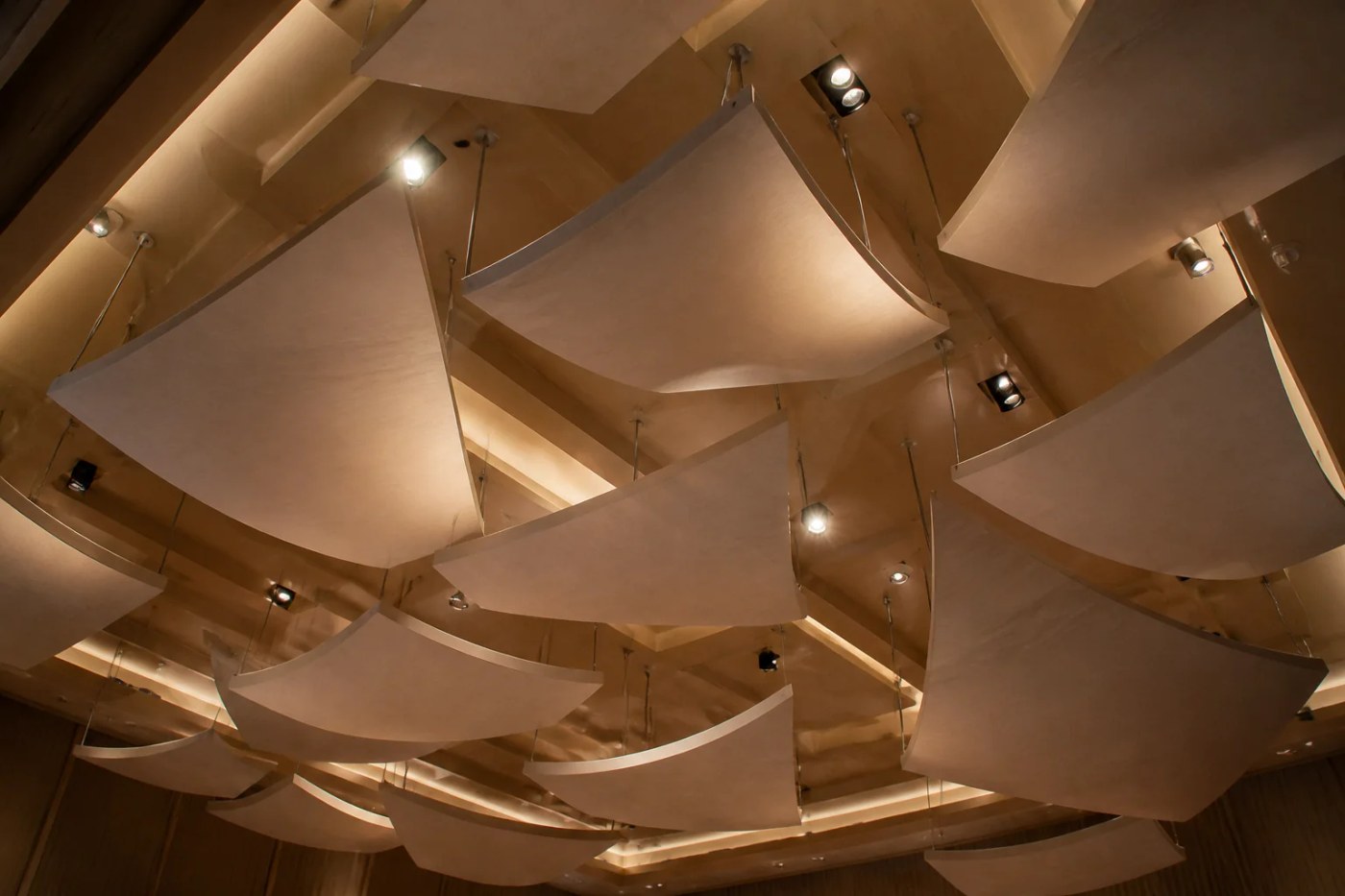
The ceiling is another major part of the acoustic environment.
Its shape, height and material can influence how sound travels between the stage, performers and audience.
Some concert halls use reflective ceiling elements or suspended reflectors to direct useful sound energy.
Other areas may require absorption to control specific reflections.
This is very different from an open-plan office, where suspended acoustic baffles may simply be used to introduce more general sound absorption.
In a concert hall, every significant ceiling element can influence the acoustic response.
Acoustic ceiling treatment should therefore be coordinated with the room's complete acoustic design.
Different Music Requires Different Acoustic Conditions
Not every concert hall is used for the same type of performance.
A room designed primarily for orchestral music may require different acoustic characteristics from a venue used for:
- Chamber music
- Choirs
- Amplified concerts
- Theatre
- Spoken presentations
- Community performances
- Multi-purpose events
This becomes particularly important in multi-purpose performing arts venues.
A reverberant environment that works beautifully for one musical performance may not provide the same clarity for amplified speech.
Some venues therefore use variable acoustic systems to modify the room's response for different events.
These may include movable curtains, banners, panels or other adjustable acoustic elements.
The fixed acoustic panels then become part of a broader strategy rather than the only method of controlling the room.
Reverberation Time in Concert Halls
Reverberation time is an important acoustic measurement, but there isn't one ideal reverberation time for every concert hall.
The appropriate condition depends on factors such as:
- Hall volume
- Type of music
- Audience size
- Seating
- Stage configuration
- Frequency
- Intended use
- Desired acoustic character
This is another reason concert hall design requires specialist analysis.
A single headline reverberation figure also doesn't describe everything about how a room will sound.
The timing and direction of early reflections, frequency response, spatial characteristics and consistency between seating positions can all influence the listener's experience.
The specification therefore needs to consider more than simply achieving an NRC value or adding a calculated number of panels.
NRC Is Not Enough for a Concert Hall
NRC, or Noise Reduction Coefficient, is useful for comparing the general sound-absorption performance of acoustic materials.
But for a concert hall, relying solely on NRC would be a major simplification.
A product's absorption varies across different frequencies.
This is particularly important for music because the room needs to handle a broad frequency range.
Two products with similar NRC values may perform differently at individual frequencies.
For critical music spaces, designers and acoustic engineers should therefore consider detailed acoustic test data, including frequency-specific absorption performance, rather than selecting products from the headline NRC figure alone.
Panel thickness, backing, air gaps and mounting configuration can also influence performance.
Acoustic Panels Around the Stage
Stage acoustics require particular care.
Performers need to hear both themselves and each other.
Reflections around the stage can therefore be useful.
Adding excessive absorption near performers could potentially remove sound energy that contributes to ensemble communication.
At the same time, uncontrolled reflections can create their own problems.
Treatment around the stage should therefore be designed according to the acoustic engineer's requirements rather than assuming that every available surface needs absorption.
In some locations, reflective or diffusive elements may be more appropriate than absorptive panels.
Audience Occupancy Changes the Room
Another important difference between concert halls and many other spaces is the acoustic effect of the audience.
People and upholstered seating absorb sound.
A full concert hall can therefore behave differently from an empty hall.
Good acoustic design considers how the room performs under realistic occupancy conditions rather than assessing only the empty space.
Seat selection and design can also influence how much the acoustic response changes between rehearsals, partially occupied events and full performances.
This is another reason acoustic treatment should be developed as part of the complete hall rather than considered as an isolated finish.
Work With an Acoustic Engineer Early
For a concert hall, specialist acoustic input should begin early in the design process.
Acoustics can influence fundamental architectural decisions such as:
- Room volume
- Ceiling height
- Wall geometry
- Stage configuration
- Balcony design
- Seating arrangement
- Surface materials
- Reflectors
- Diffusers
- Absorptive treatment
Waiting until construction is nearly complete and then trying to correct the room with acoustic panels severely limits the available options.
An acoustic engineer can establish the performance criteria, model the space and identify where absorption, reflection and diffusion should occur.
Acoustic panel manufacturers can then support that design by supplying products with the required performance, dimensions, finishes and technical documentation.
The Role of Acoustic Panels in the Specification
Once the acoustic engineer has identified where absorption is needed, the panel specification can be developed around those requirements.
Important considerations include:
- Required absorption performance
- Frequency-specific performance
- Panel thickness
- Mounting configuration
- Treatment area
- Panel dimensions
- Substrate
- Finish
- Fire performance
- Installation details
- Architectural integration
This information is more useful than a generic specification stating only "provide acoustic wall panels."
The clearer the performance requirement, the easier it is to ensure the installed treatment performs as intended.
Group 1 Fire Compliance for Class 9b Spaces
Concert halls are assembly spaces and will commonly fall within Class 9b under the National Construction Code.
Fire performance is therefore an important consideration when selecting wall and ceiling linings.
Where the applicable NCC requirements call for a Group 1 fire classification, the acoustic product and proposed configuration need appropriate evidence demonstrating that performance.
Project teams should verify:
- The building classification
- Applicable NCC requirements
- Required fire classification
- Product substrate
- Finish and configuration
- Relevant fire-test documentation
- Any conditions or limitations associated with the tested system
A fire rating should not be assumed to apply universally across every variation of an acoustic product.
The project building surveyor or certifier should confirm the requirements applicable to the specific installation.
Acoustic Performance and Architecture Should Work Together
Concert halls are often architecturally significant spaces.
Acoustic treatment may need to integrate with:
- Timber finishes
- Curved surfaces
- Geometric wall systems
- Feature ceilings
- Custom colours
- Architectural lighting
- Stage design
- Interior detailing
This creates an opportunity for acoustic treatment to contribute visually rather than appearing as an afterthought.
Panels can potentially be incorporated into architectural wall or ceiling systems while providing the specific absorption identified by the acoustic engineer.
The important point is that the visual design should not unintentionally change the acoustic function of the treatment.
Changes to materials, thicknesses, perforations, backing or installation configuration can affect performance and should be reviewed before substitution.
Choosing Acoustic Panels for a Concert Hall
Before selecting an acoustic panel, the project team should be able to answer questions such as:
- What type of performances will the hall host?
- Is the venue dedicated to music or multi-purpose?
- What reverberation characteristics are required?
- Which reflections need to be preserved?
- Which reflections need to be controlled?
- Where has the acoustic engineer specified absorption?
- What frequency-specific performance is required?
- How should the panels be mounted?
- What architectural finish is required?
- What fire classification applies?
- Does the panel configuration have suitable test documentation?
In a concert hall, the best acoustic panel is not simply the one with the highest absorption rating.
It is the panel that provides the required performance in the exact location identified by the acoustic design.
Why Choose Acoustic Panels Australia?

Acoustic Panels Australia manufactures acoustic solutions for commercial, public and performing arts projects across Australia.
For specialist spaces such as concert halls, our role is to support the acoustic and architectural specification rather than replace the acoustic engineer.
We can work with architects, designers, builders, specifiers and acoustic consultants by providing:
- Acoustic wall and ceiling solutions
- Acoustic performance data
- Frequency-specific absorption information
- Panel thickness and configuration options
- Architectural finishes
- Custom panel solutions
- Fire-performance documentation
- Samples
- Technical information
- Project-specific specification support
This allows the selected acoustic treatment to respond to both the performance requirements established by the acoustic engineer and the architectural intent of the venue.
Specifying Acoustic Panels for a Concert Hall?
Concert hall acoustics aren't about absorbing as much sound as possible.
They are about finding the right balance between liveness, clarity, reflection, diffusion and absorption.
That means acoustic treatment should be targeted to specific surfaces, supported by detailed performance data and developed in conjunction with an acoustic engineer.
When the acoustic strategy identifies where absorption is required, Acoustic Panels Australia can help translate those requirements into an appropriate panel specification.
Contact us to specify acoustic treatment for your concert hall project.